A Montessori floor bed is a low mattress placed directly on the floor, giving children freedom to enter and exit independently. It supports motor development, autonomy, and self-regulation. Most families transition between 5 and 14 months once the child is mobile, after a thorough baby-proofing of the room. Done right, it improves sleep autonomy and reduces crib-related power struggles.
The crib worked beautifully for six months. Then, one night, your baby pulled themselves up to standing and looked at you over the rail with an expression that said, very clearly, I would like to be on the other side of this, please. A few weeks later, they figured out how to swing one leg over.
This is the moment every parent who has ever owned a crib eventually faces. And it leads to a quiet question worth asking earlier than most of us do: does my child need bars to sleep safely, or do they need a room they can move through with confidence?
The Montessori floor bed offers a different answer to that question than most American parenting books. Instead of restricting movement at night and freeing it during the day, the floor bed treats sleep as another moment in a child’s day where autonomy belongs. It is not just a piece of furniture. It is a philosophy of trust applied to the night.
What Is a Montessori Floor Bed?
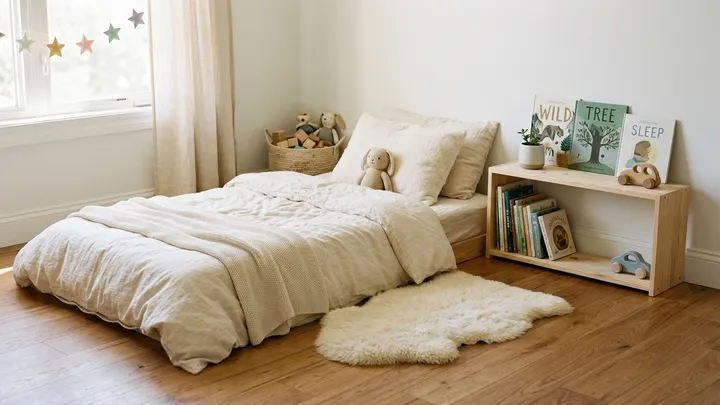
A Montessori floor bed is exactly what it sounds like: a mattress placed directly on the floor, with no frame raising it more than a few inches off the ground. The child can climb in and out independently from the moment they are mobile.
Some families use a twin mattress on the floor with no frame at all. Others use a low wooden platform that lifts the mattress 4-6 inches for airflow. Both qualify as Montessori floor beds. The defining feature is not the wood or the platform style. It is the height, the accessibility, and the message it sends: this is your bed, you are in charge of it.
There is nothing magical about the mattress itself. The transformation happens because the bed is part of a thoughtfully prepared environment. A floor bed in a chaotic, unsafe room is just a mattress on a floor. A floor bed in a fully baby-proofed room becomes the foundation for sleep autonomy, self-regulated rest, and a child’s first lesson in being trusted with their own body.
The Philosophy Behind It: Freedom of Movement at Night
Maria Montessori observed that children have a profound, biological need to move. She wrote that movement is not separate from intelligence — it is intelligence in action. Restricting movement, she argued, restricts development.
Most Western parenting separates these ideas: we want active, engaged, capable children during the day, but we restrain them in cribs at night. The Montessori floor bed dissolves that contradiction. If we trust a child to navigate a playroom safely at 14 months, we can trust them to navigate a sleep space too, provided that space is properly prepared.
The philosophy rests on three pillars:
Trust the child. Children are competent. Given a safe environment, they make reasonable decisions about their own bodies. A 12-month-old who is tired will lie down. A 12-month-old who is not tired will not be tired just because we put bars around them.
Prepare the environment, not the child. Instead of training a child to comply with sleep restrictions, the Montessori approach prepares an environment that supports natural sleep rhythms. The work moves from the child to the room.
Sleep is a relationship, not a battle. Cribs frame sleep as something parents impose. Floor beds frame sleep as something families participate in together. The child has agency. The parent has presence. There is less to fight about.
Maria Montessori wrote in The Discovery of the Child: “The child becomes a person through work, and the work of childhood is to construct the self.” Restricting where a child can be — even at night — restricts that work.
Research-Backed Benefits
The benefits of floor beds are not theoretical. Several lines of research support what Montessori observed a century ago.
1. Better Motor Development
Children with unrestricted movement at night show improved gross motor milestones, especially in mobility transitions. Pediatric occupational therapists frequently note that infants in floor beds reach crawling, cruising, and walking milestones at the upper end of typical ranges. The reason is simple: the child practices these skills more often.
A child in a crib has a movement vocabulary limited to standing, sitting, lying down, and shaking the rails. A child in a floor bed practices crawling, climbing, transitioning between surfaces, and the complex sequence of getting in and out of bed — all useful motor skills.
2. Improved Sleep Self-Regulation
The most common parental fear is that children will not stay in bed. Studies on child sleep behavior consistently show the opposite once the transition period passes: children with sleep autonomy show better self-regulated sleep onset, fewer night wakings requiring parent intervention, and more consolidated sleep by age 2.
The mechanism appears to be that children in floor beds learn to recognize their own sleep cues. They lie down when tired because no one forced them to lie down when they were not. This is a learned skill that crib sleep can actually delay.
3. Reduced Power Struggles
Bedtime battles are one of the most exhausting parts of early parenting. They are also largely an artifact of restrictive sleep environments. When a child cannot leave the crib, the crib becomes a battleground. When a child can come and go freely, there is much less to fight about.
This does not mean a floor bed makes bedtime effortless. It means the conflict shifts from “you must stay in this confined space” to “we are doing our bedtime routine, then you have your own room where you can rest.” The second framing is easier for both parent and child.
4. Cognitive Benefits of Autonomy
A 2018 review in Developmental Psychology found that early childhood autonomy in routine daily tasks — including sleep transitions, dressing, and feeding — was associated with stronger executive function in early school years. The floor bed is one of the earliest opportunities for genuine autonomy.
The benefits show up not in the bedroom but in the classroom years later: better self-regulation, stronger sense of self-efficacy, and more confident risk assessment.
When to Start: An Age-by-Age Guide
There is no single “right age” for a Montessori floor bed. The right time depends on your child’s mobility, your room’s safety, and your family’s readiness. Here is a guide.
Birth to 5 Months
Many Montessori families introduce a floor mattress at birth. At this stage it functions like a bassinet on the floor: the baby is placed on their back to sleep and cannot yet roll or move independently. The floor bed during this period is primarily symbolic — it establishes the room and the philosophy before mobility begins.
If you choose to start at birth, follow the same safe sleep guidelines as any infant: firm mattress, no loose bedding, no pillows or stuffed animals, room temperature 68-72°F, and supervised sleep until standard pediatric guidelines clear independent sleep.
5-8 Months: The Rolling Stage
This is when many families transition. The baby is rolling, perhaps sitting up, but not yet crawling far. A floor bed at this stage is safe because the baby cannot travel meaningfully across the room, but it begins to support sleep autonomy.
The critical preparation is making sure the immediate area around the bed is soft, clean, and free of small objects. A small play mat, a quiet wall-side placement, and basic baby-proofing are enough.
8-14 Months: The Mobile Stage
Crawling, cruising, and early walking. This is the classic window for the floor bed transition. The child can now leave the bed, and the entire bedroom must be ready for that.
Full baby-proofing is required: every outlet covered, all furniture anchored to walls, no cords accessible, all small objects out of reach, and a closed door with a gate or child-proof handle. The bedroom is now the safety zone, and everything within it must be evaluated.
14-24 Months: Toddler Transition
If you did not start earlier, this is the most common transition window. Children at this age understand and follow simple routines, can communicate basic needs, and benefit enormously from the autonomy a floor bed provides.
The conversation can be more explicit: “This is your bed. You can get in when you are tired and you can call for me if you need me.” Most toddlers in this window adapt within 1-2 weeks.
2-5 Years: From Crib Holdout to Floor Bed
If you held off until now, the transition is straightforward but the child has more opinions. Involve them in the setup: let them help arrange pillows, choose bedding, and place a few favorite stuffed animals. Make the new bed feel like a privilege, not a punishment for outgrowing the crib.
At this age, the philosophical conversation can be more direct: “You are big enough to have your own bed now. Big means you get to choose when to sleep, but big also means you stay in your room until morning.”
Safety Setup: The Whole-Room Approach
The floor bed itself is not the safety challenge. The bedroom is. A floor bed in an unsafe room is dangerous; a floor bed in a fully prepared room is the safest sleep environment your child has ever had.
Here is the complete checklist.
Furniture and Fixtures
- Anchor everything to walls. Dressers, bookshelves, low furniture — all of it. Use furniture straps designed for tip-over prevention. A toddler can pull a 200-pound dresser over with surprisingly little effort.
- Choose low, sturdy furniture. If a child can climb it, they will. Low shelves are safer than tall ones because the fall distance is shorter and they are less likely to tip.
- Remove anything with sharp corners at child height. Replace tall lamps with sconces. Consider corner bumpers on furniture that must stay.
Electrical and Cords
- Cover every outlet with tamper-resistant covers or full outlet plates. Standard plug-in covers can be a choking hazard if removed.
- Eliminate all cords within reach. Window blind cords, lamp cords, phone chargers, baby monitor cables. If a cord exists in the room, it must be inaccessible.
- Battery-powered baby monitors are safer than plug-in models. If you must use a plug-in, mount it high on the wall and route the cord behind furniture.
The Door as a Safety Boundary
This is the single most important concept. The bedroom door is not just a door — it is the boundary between a safe room you have prepared and a house you cannot fully baby-proof.
- Use a baby gate at the door or a child-proof door knob cover that prevents the child from leaving the room.
- Train the child early that the door stays closed at night. Most accept this within days, especially if the room itself is engaging.
- Never lock a child in with a key-operated lock. Use child-proof handles that adults can open easily in an emergency.
Sleep Surface
- Mattress firmness: Firm enough to meet safe sleep standards for infants. Even for older children, very soft mattresses can pose risks.
- No loose bedding for children under 12 months. For toddlers, a small pillow and a fitted blanket are fine.
- Avoid mattress toppers, weighted blankets, and oversized stuffed animals in the bed for children under 3.
- Mattress placement: Against a wall is generally fine. Avoid placing it under a window, near radiators, or directly against an outlet wall.
The 30-Minute Test
Before declaring the room safe, sit on the floor in the middle of the room. Look at the room from a toddler’s eye level. What can you reach? What looks interesting? What is unsafe? Test every cabinet, every drawer, every cord, every outlet. If anything is reachable that should not be, fix it.
A practical note: If the floor-bed transition feels overwhelming, this is usually because the room is not yet ready. The bed is easy. The room takes a weekend of focused work. Do that work first, and the rest follows naturally.
Setting Up the Bedroom Around the Floor Bed
A Montessori bedroom is more than a bed. It is a complete environment that supports independence, calm, and developmentally appropriate engagement. Here is how to set up the rest of the room.
Reading corner. A low basket of board books and a soft cushion or sheepskin on the floor. Rotate 4-6 books at a time so the selection feels fresh without being overwhelming.
Low mirror. A wall-mounted, child-height mirror near the floor bed supports self-recognition and is fascinating to infants and toddlers. Use shatter-resistant acrylic, not glass.
Open shelf with a few activities. Two or three quiet activities the child can engage with during morning wake-up time before parents come in. Examples: a simple wooden puzzle, a fabric basket, a small soft animal. The shelf signals that the child can do something on their own.
Wardrobe accessible to the child. A low rod with a few outfits the child can choose between, plus a small chair or stool for getting dressed. Even toddlers as young as 18 months can begin to participate in dressing themselves.
Lighting that matches the time of day. Soft, warm light for evening. A blackout curtain for nap time and early-morning light control. A small night light if needed, placed low and dim.
Nothing else. Resist the urge to fill the room. Less furniture means more open floor for movement, fewer hazards, and a calmer environment.
Transitioning From a Crib: A Practical 3-Week Plan
The transition is rarely instant. Here is a plan that has worked for many families.
Week 1: Preparation Without the Bed
Before introducing the floor bed, finish all baby-proofing. Walk through the 30-minute test above. Do not skip this step, even if you are excited to make the change.
During this week, the child still sleeps in the crib. The work is entirely on the room.
Week 2: Side-by-Side
Set up the floor bed alongside the crib. Give the child the choice of where to sleep. Many children naturally migrate to the floor bed within a few days, especially for naps. Allow the choice; do not push.
If your child only uses the crib, that is fine. The floor bed is in the room, and they are getting used to its presence. Read books together on the floor bed during the day. Let it become a familiar surface.
Week 3: Remove the Crib
Once the child has consistently chosen the floor bed for at least 3-4 nights, remove the crib from the room. Frame the change positively: “Your crib is going to a new home because you have your big-kid bed now.”
Expect 3-7 nights of adjustment. Some children sleep less, some test the new freedom by getting up repeatedly. This is normal and short-lived. Hold the routine. Within two weeks, the floor bed becomes the new normal.
Common Concerns Answered
“My child will get up all night.” Some do, briefly, in the first week. With a calm response (walk them back, no screen time, no engagement) and a fully prepared room, most settle within 1-2 weeks.
“What about safety if I am asleep?” The whole-room approach is the answer. A baby-proofed room with a closed door is safer than a crib in a room with an unanchored dresser. The threat is rarely “child gets out of bed.” It is “child encounters something dangerous.” Eliminate the dangerous, and the bed is fine.
“We have stairs.” A closed bedroom door with a baby gate or child-proof handle keeps the child in the room. Many families also place a second baby gate at the top of any stairs as a redundancy.
“What about the cat or dog?” Keep pets out of the bedroom at night, especially during the transition. Once the child is older (2+), most families introduce supervised pet visits before bedtime as part of the routine.
“My partner is not on board.” This is the most common real obstacle. The most useful approach is to start with one nap a day in the floor bed. Reluctant partners often come around once they see the child napping peacefully and getting up calmly. Concrete results are more persuasive than philosophy.
Top 5 Montessori Floor Beds
These picks balance safety, durability, and aesthetic. All are available on Amazon.
1. Cribsie House-Frame Floor Bed
A timeless house-frame design that doubles as imaginative play architecture. Low to the ground, sturdy construction, no sharp edges. Fits a twin mattress.
Best for: Toddlers and preschoolers who enjoy imaginative play. Lasts through age 7+.
2. Sweet Home From Wood Floor Bed Frame
Simple, low Scandinavian-style platform that lifts a twin mattress 4 inches off the floor — enough for airflow without compromising the floor-bed philosophy. Solid pine, non-toxic finish.
Sweet Home From Wood Floor Bed
Best for: Families who want a clean, minimalist look that fits any bedroom style.
3. Busywood Montessori Floor Bed with Rails
For families nervous about the no-rail approach, this design offers low rails on three sides that can be removed once your child is comfortable. A compromise that works for hesitant first-timers.
Busywood Montessori Floor Bed with Rails
Best for: First-time floor bed families who want a transitional safety feature.
4. Just a Twin Mattress on the Floor
Honestly, this is what most Montessori educators actually recommend. A quality twin mattress placed directly on the floor, with no frame, no rails, no extras. The simplest, safest, most philosophically pure version of the floor bed.
Best for: Purists, small budgets, and families who value simplicity.
5. Full-Size Floor Bed for Long-Term Use
If you anticipate co-sleeping during illness, room-sharing with a sibling, or just want a bed your child uses through elementary school, a full mattress on a low platform is the best long-term investment.
Zinus Full-Size Low Profile Frame
Best for: Long-term planning. Bed lasts from infancy through age 10+.
Disclosure: As an Amazon Associate, we earn from qualifying purchases. This does not affect the price you pay or which products we recommend.
The First 30 Days: What to Expect
Days 1-3. Excitement, novelty, some wandering. Expect 1-2 extra wake-ups per night and a longer bedtime routine as your child explores the new arrangement.
Days 4-7. A second wave of disruption as the novelty fades but the child is still recalibrating. Some children sleep worse this week before they sleep better. Hold the routine.
Days 8-14. Settling. Most children find their rhythm in this window. They get up briefly when they wake, then return to bed on their own. Sleep quality begins to surpass crib sleep.
Days 15-30. New normal. The floor bed feels like the right bed. Bedtime routines stabilize. Many parents notice their child sleeping more deeply because there is no waking-and-shaking-the-rails ritual when they stir.
If the transition is not working by day 30, the issue is usually in the environment, not the bed. Walk through the safety checklist again. Look at light, noise, temperature, and what is on the shelves at child height. Adjust one variable at a time.
A Final Thought
The Montessori floor bed is not a piece of furniture. It is a statement about what kind of relationship you want to have with your child around rest, autonomy, and trust. The bed itself is just wood and fabric. The shift is in the parent.
Most families who make the change report something unexpected: their evenings become calmer. There is less to fight about, less to negotiate, less to feel guilty about. The child sleeps in the same room as before, but the room is no longer a battlefield. It is a place the child wants to be.
If you are nervous, start with naps. If you are confident, start tonight. Either way, prepare the room first, trust the child once the room is ready, and give the transition the two weeks it deserves before you judge whether it worked.
It usually works.