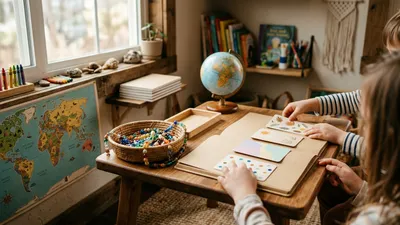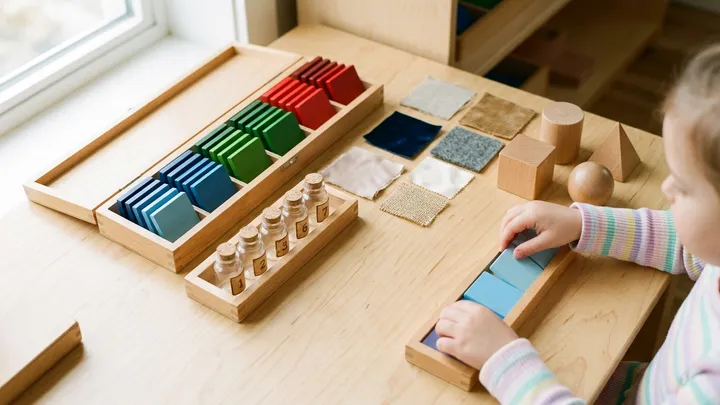
Montessori sensorial materials are precisely designed objects that isolate a single sensory quality — dimension, color, weight, texture, sound, smell, taste — so the child can perceive that quality directly. They develop the senses, refine perception, and prepare the child for later abstract work in math, geometry, music, and language.
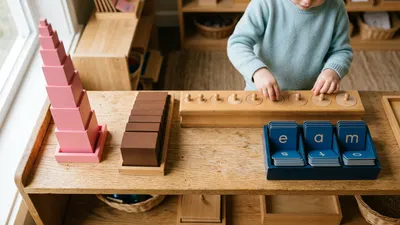
In every authentic Montessori classroom there is a shelf, often arranged near a window where the light is good, with a set of objects unlike any other toys in the room. They are spare, beautiful, and slightly mysterious. A graduated pink tower. A series of brown rectangular prisms. A box of color tablets. A wooden cabinet with cylinders that fit precisely into matching holes.
These are the sensorial materials. They have been used in Montessori classrooms for over a century. They were designed with such precision that they remain essentially unchanged from Maria Montessori’s original designs in the early 1900s. And they do something most other educational materials do not: they teach the senses themselves.
This guide explains what sensorial materials are, why they matter, the complete sequence, and how to use them at home — whether your child attends a Montessori school or you are building a home program from scratch.
What Sensorial Materials Actually Do
Most people, asked what a child does at school, would say: learn to read, learn to do math, learn facts. Few would say: learn to perceive. But perception is a learned skill. A trained sommelier perceives differences in wine that the rest of us miss entirely. A trained musician hears intervals we cannot consciously identify. A trained tailor sees fabric distinctions invisible to most.
Sensory perception is trainable, and the early years are the optimal time to train it. Maria Montessori observed that between roughly 2.5 and 6, children are in a sensitive period for refining the senses. They have an intense, almost obsessive interest in noticing small differences — between two similar colors, two close pitches, two related shapes, two distinct textures.
The sensorial materials channel this interest. Each material isolates one sensory quality and grades it carefully. The child works with the material, perceives the gradation, and develops finer and finer discrimination.
The result is not just better senses. It is a more refined cognitive apparatus. A child who has learned to distinguish ten shades of red can also distinguish ten levels of meaning in a sentence. A child who has felt the precise difference between rough and smooth can also feel the difference between right and almost-right in their own work. Sensorial training builds the basic infrastructure for all later thinking.
The Core Sensorial Materials
The Montessori sensorial curriculum has around 25 distinct materials. Here are the most important.
Visual Materials
Pink Tower. Ten pink wooden cubes graded from 1cm to 10cm. The child builds them in order, smallest on top to largest on bottom. The tower develops visual discrimination of size in three dimensions and prepares directly for cubing and volume concepts later. Probably the most iconic Montessori material.
Brown Stair. Ten brown rectangular prisms graded by width (and depth), but all the same length. Arranged in a staircase, they develop visual discrimination of width. Used with the pink tower to compose more complex constructions.
Red Rods. Ten red wooden rods graded by length, from 10cm to 1 meter. The child arranges them in a stair pattern. Develops visual discrimination of length. These become the number rods later, used to introduce mathematical concepts.
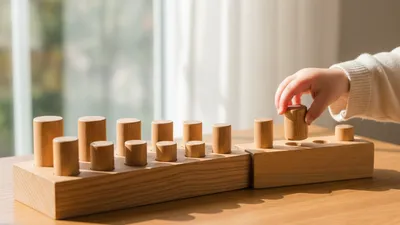
Knobbed Cylinders. Four wooden blocks, each with ten cylinders graded in dimension. The child removes the cylinders, scrambles them, and replaces them in the correct holes. The control of error is automatic: a wrong cylinder will not fit. Develops dimension discrimination and prepares for writing (the small knob is held like a pencil).
Knobless Cylinders. The same shapes as knobbed cylinders but without holes to constrain them. The child can arrange, stack, and combine them creatively. Develops dimension perception with greater freedom.
Color Tablets (Boxes 1, 2, and 3). Wooden tablets in graduated colors. Box 1: the three primary colors. Box 2: the six basic colors plus pink, gray, white, black, and brown. Box 3: seven colors each in seven gradations. Develops color discrimination from basic to highly refined.
Geometric Solids. A set of ten solid shapes (cube, sphere, cone, cylinder, etc.). Children explore them tactilely, often blindfolded, and learn to identify each shape. Prepares for solid geometry and architecture.
Geometric Cabinet. A cabinet with drawers, each containing flat geometric shapes (triangle, square, rectangle, polygons, curved figures). Children match the shapes to outlines on cards. Prepares for plane geometry and visual recognition of shapes in the environment.
Auditory Materials
Sound Boxes. Two sets of small wooden cylinders, each containing a different sound material (sand, beans, rice). The child shakes and matches pairs that sound the same. Develops auditory discrimination.
Bells. A set of 26 musical bells in two of each pitch across an octave plus accidentals. The child matches them by pitch, then grades them in order. Prepares for music theory and pitch perception.
Tactile Materials
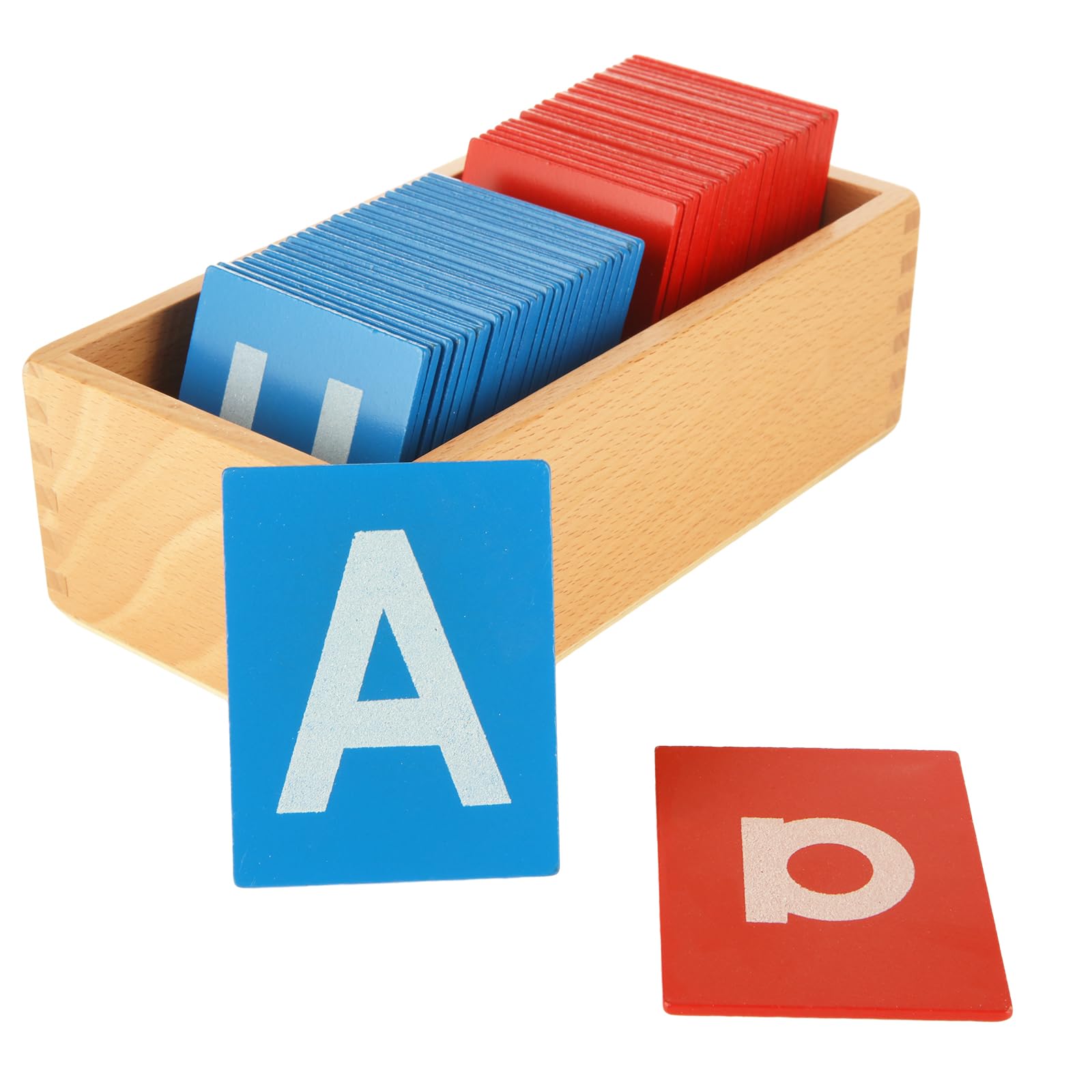
Rough and Smooth Boards. Boards with sandpaper of varying coarseness. Children pass their fingertips across them, developing tactile sensitivity. Prepares for the sandpaper letters and tactile reading of all kinds.
Fabric Box. Pairs of fabric squares in different materials. Children match them by touch, often blindfolded. Develops tactile discrimination.
Thermic Tablets. Tablets in different materials (wood, metal, marble, felt) that conduct heat differently and thus feel different temperatures even at room temperature. Children pair them by thermal sensation.
Baric Tablets. Wooden tablets of identical size but different weights (different woods). Children pair them by weight, often blindfolded. Develops baric (weight) discrimination.
Olfactory Materials
Smelling Bottles. Small sealed bottles containing different aromatic substances (clove, cinnamon, mint, lavender). Children pair them by smell. Develops olfactory discrimination and vocabulary.
Gustatory Materials
Tasting Bottles. Small bottles or droppers with solutions of different tastes (salty, sweet, sour, bitter). Children identify and pair tastes. Develops taste discrimination.
How to Present a Sensorial Material
Montessori presentations of sensorial materials follow a specific pattern that is worth understanding.
1. Invitation. Show the child the material is available, often with a brief: “Would you like me to show you something?”
2. Carry. Demonstrate how to carry the material from shelf to work surface, with appropriate care (two hands, slowly, respectfully). The child observes.
3. Demonstration. Use the material once, slowly, with minimal words. Children learn by watching the hands, not by listening to explanation. Speak only essential words.
4. Hand off. “Would you like to try?” Step back and let the child use the material. Resist the urge to correct.
5. Observation. Watch what the child does. Note where they struggle, what interests them, when they seem ready for the next step.
6. Return. Demonstrate how to put the material away (each piece, in its place, on the shelf, in the correct orientation). The return is part of the work.
A presentation typically lasts 3-7 minutes. The child’s subsequent work can last 15 minutes to over an hour. Avoid interrupting once the child is engaged.
The Three-Period Lesson
Sensorial materials often pair with the three-period lesson, a precise vocabulary-teaching method.
Period 1: Naming. Adult: “This is rough. This is smooth.” Hand the child each tablet as you say its name. Repeat naturally over the work session.
Period 2: Recognition. Adult: “Show me rough. Show me smooth.” The child points or picks up. This is the longest period — most of the vocabulary learning happens here. Stay in this period for multiple sessions if needed.
Period 3: Recall. Adult points to one and asks: “What is this?” The child names it.
The three-period lesson teaches not just the sensory quality but the precise vocabulary attached to it. After this lesson, the child knows the word and the experience inseparably.
Sequence and Pacing
There is no rigid order, but a general progression helps.
Phase 1: Visual materials. Start with the pink tower, brown stair, and red rods. These teach the foundational visual discrimination skills and engage most children immediately. Add knobbed cylinders once these are familiar.
Phase 2: Color tablets. Begin with Box 1 (primaries). Introduce Box 2 once primary colors are mastered. Box 3 may not be appropriate until later in the primary years.
Phase 3: Auditory. Sound boxes are accessible to most 3-year-olds. The bells are usually introduced around 4-5 because they require musical concentration.
Phase 4: Tactile. Rough and smooth boards prepare for the sandpaper letters and should come around the time letters are introduced (3.5-4.5).
Phase 5: Geometric. Geometric solids and the geometric cabinet typically come around 4-5 as the child develops abstract shape recognition.
Phase 6: Olfactory, gustatory, thermic, baric. These can be introduced anytime between 3 and 6, depending on interest and access.
Within each material, there are extensions and refinements — using the pink tower blindfolded, building it with eyes closed, constructing combinations of pink tower and brown stair, doing the cylinders by touch alone. A material that seems simple at first can be revisited at increasing levels of difficulty for years.
At Home: A Realistic Setup
You do not need every material to do meaningful sensorial work at home. Here is what a working home sensorial shelf might look like.
Starter set (~$200-300):
- Pink tower
- Brown stair
- Red rods (or simpler color rods for younger children)
- Color tablets Box 1
- Sound boxes (or DIY: small jars with different fillings)
- Smelling bottles (easy DIY with spice jars)
- Rough and smooth boards (DIY with sandpaper grades)
Add over the first year (~$200):
- Color tablets Box 2
- Knobbed cylinders
- Geometric solids
- Fabric box (DIY)
Add as the child grows (~$300):
- Color tablets Box 3
- Knobless cylinders
- Geometric cabinet
- Bells (or simpler music materials)
- Thermic and baric tablets
A complete home sensorial program for primary ages can be built for $500-700 over 2-3 years.
Where to buy: Nienhuis Montessori (authentic, expensive), Alison’s Montessori (good quality, mid-range), Adena Montessori (affordable), and many DIY resources on Etsy. Quality matters most for the materials whose lessons depend on physical precision (pink tower, knobbed cylinders, geometric cabinet).
What These Materials Are Not
Sensorial materials are not toys. The distinction matters.
Toys are designed for play with high stimulation, novelty, and entertainment. Sensorial materials are designed for work — focused, repetitive, transformative engagement with a specific quality. The child’s relationship to the material is different.
This means: the materials live on a shelf, not in a toy box. They are used one at a time, on a dedicated work surface. They are returned to their place after use. They are treated with care. Children rise to the dignity of the materials when adults treat them this way.
Sensorial materials are also not crafts. The child does not “create” with them in an open-ended way (until later, in more advanced extensions). The materials have right and wrong uses. The pink tower is built one specific way. This is not restrictive — it is what allows the material to teach what it teaches.
When the Senses Are Refined
The deepest gift of sensorial work shows up not in childhood but in adulthood. A person whose senses have been refined experiences the world with more depth. They notice the gradations of light in a sunset that most people miss. They taste the layers of complexity in a meal that others eat without attention. They hear the structure of a piece of music that others register only as background noise.
Maria Montessori called this “the education of the senses.” It is, in her words, “the preparation for the abstract life of the spirit.” Whether or not you accept that framing, the practical result is the same: a person whose senses have been trained perceives more of life. They are awake in their bodies and in their environment.
That is what these materials, set up on a shelf in a quiet room, slowly produce in a child over years. It is not a result you can measure on a test. But it is what the parent eventually sees, and what the child eventually lives.
If you want one place to begin, start with the pink tower. Buy a good one. Put it on a low shelf. Show your child how to build it. Then sit back and watch what happens when a small human is given a precise and beautiful object to work with, in silence, for as long as they want.
That moment is the entire method, distilled.