The Montessori method is an educational approach developed by Dr. Maria Montessori in the early 1900s. It is built on the idea that children learn best through self-directed activity in a carefully prepared environment, supported by trained adults who observe rather than direct. The method emphasizes independence, concentration, mixed-age learning, and respect for the child as a competent individual.
If you have spent any time looking into childhood education, you have probably heard the word Montessori in three very different contexts. There is the school down the street that uses the name. There is the wooden toy aisle on Etsy. And there is a quiet, persistent reputation that something about this method produces remarkably independent, focused children — and many people are not entirely sure why.
This guide is for parents who want to understand what the Montessori method actually is, where it came from, why it works, and what to do with that information. We will not romanticize it (it is not magic) or oversell it (it does not produce perfect children). We will explain it clearly and let you decide whether it fits your family.
A Different Premise About Childhood
Most educational systems start from an assumption: children do not know what they need to learn, so adults must decide and deliver it to them in the right order, at the right pace. This is the model behind grade levels, lesson plans, standardized testing, and most of what we recognize as school.
The Montessori method starts from a different premise. Children are not empty vessels waiting to be filled. They come into the world with a built-in drive to learn, and that drive has its own intelligent sequence. The adult’s job is not to impose learning on the child but to prepare an environment where the child’s natural development can unfold.
This sounds romantic until you spend time in an actual Montessori classroom. What you see is not chaos. It is the most calm, focused group of children you have ever encountered, each absorbed in a different activity, working independently for hours. The order is not imposed by adults — it emerges from children who are doing what they actually want to do.
That observation, repeated thousands of times by Maria Montessori and the educators she trained, is the foundation of the entire method.
A Brief History
Maria Montessori was born in Italy in 1870. She trained as a physician at a time when women rarely did, then specialized in working with children who were considered “uneducable” — many of whom were institutionalized for cognitive or developmental differences. Working with these children, she observed something the existing system could not see: when given hands-on materials they could manipulate independently, even severely delayed children learned far more than anyone expected.
In 1907 she was given the opportunity to apply her approach to ordinary children in a Rome housing project. The school was called Casa dei Bambini (“Children’s House”). What happened there made her famous. Within months, children as young as 3 were reading and writing. They moved through advanced math materials by age 5. They cleaned up after themselves. They settled disputes. They sat in deep concentration for hours.
Educators from around the world came to see what was happening. Within a decade, Montessori schools opened in dozens of countries. Maria spent the rest of her life refining the method, training teachers, and writing the books that would carry it forward.
She died in 1952. By then, her method covered every developmental stage from birth to adolescence and was practiced on every continent.
The Five Core Principles
The Montessori method is not a single technique. It is a system of interlocking principles. Understanding them separately is useful, but the power comes from how they work together.
1. The Prepared Environment
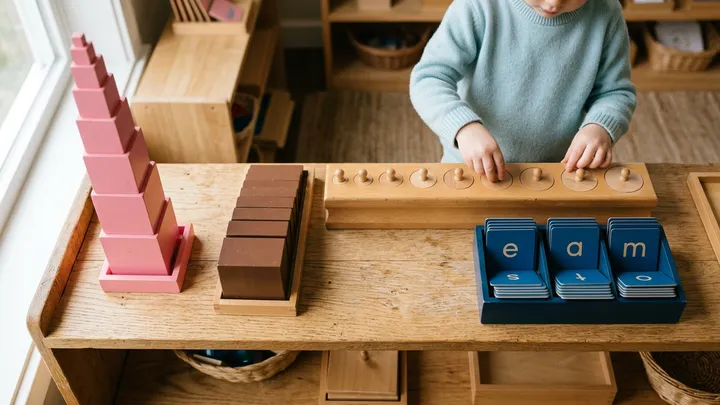
The room itself teaches. Every element is intentional: low shelves so children can reach materials independently, child-sized furniture so they can use it without adult help, real (breakable, sharp, fragile) tools so children learn care, beauty in every detail so children develop aesthetic sensitivity, and order everywhere so children learn that things have a place.
A prepared environment is not just a child-friendly room. It is a learning instrument designed for the specific developmental needs of the children who use it. The toddler environment is different from the primary environment, which is different from the elementary environment. Each one is built to support the work appropriate to that stage.
2. Freedom Within Limits
Children in a Montessori classroom have freedoms that surprise visitors: freedom to choose their own work, freedom to move around the room, freedom to work as long as they want, freedom to talk with other children, freedom to use any material they have been shown.
But these freedoms exist within clear limits: you must use materials respectfully, you must put work away when you are done, you may not interrupt another child’s work, you may not be unkind to another person. The limits are firm. The freedoms are real. This combination is harder to maintain than it sounds and produces remarkable self-regulation in children.
3. The Three-Hour Work Cycle
Most Montessori classrooms have a single 3-hour block of uninterrupted, self-directed work. Children choose their activities, change activities at will, and work for as long as their interest holds. There are no bells, no scheduled transitions, no whole-class lessons that pull everyone out of what they are doing.
The length matters. Deep concentration takes time to develop. The first 30-45 minutes of a work cycle are often the noisiest and least productive. The middle hour is where children settle into deep work. The final hour is where the most profound concentration happens. Interrupting this with a lesson or transition destroys the cycle.
This is one of the hardest things for parents to understand and one of the most important. The 3-hour work cycle is not a scheduling preference. It is a structural requirement for the kind of learning Montessori produces.
4. The Adult as Observer and Guide
A Montessori teacher (called a “guide” or “directress”) does not stand at the front of the room and lecture. She moves quietly through the classroom, observing what children are doing, offering individual lessons when a child is ready for the next concept, and stepping back so the child can practice.
A typical Montessori lesson lasts 5-10 minutes, is given to one or two children, and consists mostly of demonstration with minimal words. The child then practices the work alone, sometimes for hours, sometimes returning to it day after day for weeks.
The teacher’s primary skill is observation: noticing when a child is ready for the next material, when they need more practice with the current one, when they are getting distracted because the work is too easy, when they are frustrated because it is too hard. This is precise, attentive work, but it does not look like teaching in the conventional sense.
5. Hands-On Materials That Teach
The Montessori materials are famous. They are also widely misunderstood. They are not toys. They are not arts and crafts supplies. They are precisely designed instruments for teaching specific concepts.
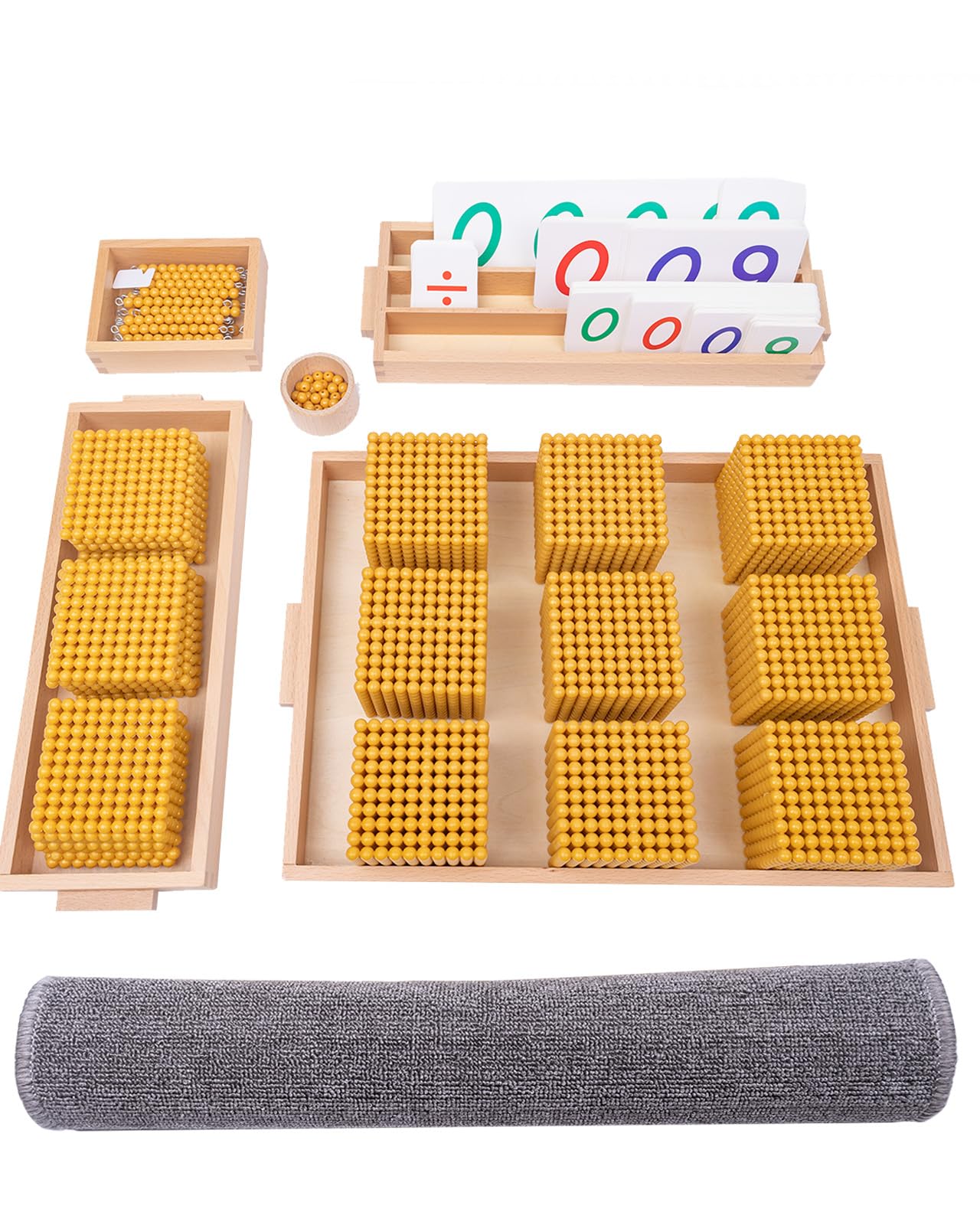
Each material isolates a single property: the pink tower teaches dimension, the smelling bottles teach olfactory discrimination, the bead chains teach the structure of numbers. Each material is self-correcting: the child can see when they have used it wrong without an adult pointing it out. Each material progresses from concrete to abstract: children handle physical representations before working with symbols.
The result is that Montessori children develop concrete understanding of concepts that, in traditional schools, are introduced abstractly and then memorized. A Montessori child who builds the thousand cube with bead bars literally knows what a thousand is. A child who memorizes “1000” from a textbook knows the symbol.
Sensitive Periods
One of Maria Montessori’s most important observations was that children have specific developmental windows — she called them sensitive periods — when learning a particular skill is effortless and joyful.
The major sensitive periods are:
- Language (birth to 6 years, with intense windows at specific ages)
- Order (around 18 months to 2.5 years)
- Movement (birth to 4 years, with refinement continuing later)
- Small objects (around 18 months to 3 years — the source of the obsession with picking up lint and tiny crumbs)
- Refinement of the senses (2-4 years)
- Social behavior (around 2.5-6 years)
- Writing (around 3.5-4.5 years, often before reading)
- Reading (around 4-5 years, after writing)
- Mathematics (around 4-6 years)
A child in a sensitive period for language absorbs vocabulary like a sponge — they can learn three languages with the same ease that takes adults years. A child in a sensitive period for order needs predictable routines and tolerates change poorly. A child in a sensitive period for movement needs constant opportunities to practice.
The Montessori curriculum is built around these windows. Materials are introduced when the child is in the relevant sensitive period, which is why so much serious academic work happens in early childhood in Montessori — the child is biologically primed for it.
A practical implication: If your toddler insists on a specific routine, asks for the same book ten times in a row, or melts down when you take a different route to the park, this is not stubbornness. It is the sensitive period for order at work. Honoring it (within reason) supports development. Fighting it makes everyone miserable.
What Montessori Looks Like in Practice
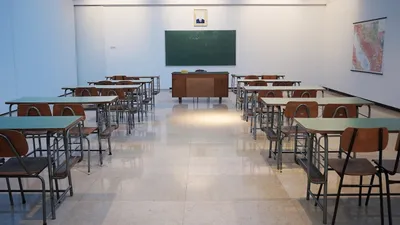
A primary (3-6) Montessori classroom on a typical morning has 25-30 children. There are no rows of desks. Instead, there are tables and rugs scattered around a large, calm room. Materials line low open shelves around the perimeter, each one in its place, each one inviting.
When you walk in, you see something striking: every child is doing something different. One child is polishing a brass bell on a small tray. Two children are working with the bead chains, building the thousand chain across the rug. A 4-year-old is writing words with a moveable alphabet. A 5-year-old is reading quietly. A 3-year-old is washing a small piece of laundry in a child-sized basin.
The teacher is mostly invisible. She is sitting next to one child, giving a lesson on a new material. She watches another child carefully and makes a mental note. She gently redirects a 4-year-old who is wandering. She is everywhere and nowhere at once.
What you do not see: a teacher lecturing, children sitting at desks, anyone shushing anyone, a worksheet, a poster of the alphabet on the wall, a reward chart, a time-out chair.
This is what 30 children of mixed ages working freely actually looks like. It does not look like our cultural image of school. That is part of why it is so effective.
Does Montessori Work? The Research
The evidence base is solid but smaller than for some other educational approaches. Several key findings:
A 2017 study in Frontiers in Psychology followed children at a public Montessori magnet school and compared them to lottery-controlled peers in traditional schools over 3 years. The Montessori children showed greater gains in academic achievement, social understanding, and mastery orientation. The achievement gap that exists between higher and lower-income peers in traditional schools narrowed substantially in the Montessori program.
A 2006 Science study by Angeline Lillard and Nicole Else-Quest compared 5- and 12-year-olds in Montessori and non-Montessori schools. Montessori students performed better on tests of reading, math, executive function, and social cognition. They also reported a stronger sense of community at school.
Long-term follow-up studies (such as those by Lillard and her colleagues over the past decade) consistently find that Montessori students show stronger executive function, better social skills, and comparable or better academic outcomes than peers in traditional programs.
The research is not unanimous, and effects depend heavily on whether a program is authentically Montessori or only nominally so. But for high-fidelity Montessori programs, the evidence is encouraging.
Common Misconceptions
Montessori is permissive. No. It is one of the most disciplined educational approaches that exists, but the discipline comes from clear expectations and meaningful work, not from adult control or rewards.
Montessori is for gifted children. No. The method was originally developed for children considered “uneducable” and works across the full range of cognitive abilities. It is particularly effective for children who struggle in conventional classrooms.
Montessori children cannot transition to regular school. Most do so successfully. Studies show Montessori-educated children typically adjust well to conventional schools after the elementary years, often with strong academic preparation and independent work habits.
Montessori is anti-technology. Maria Montessori embraced the latest tools and methods of her time. Modern Montessori programs vary on technology — some integrate it carefully, others restrict it for younger ages. The principle is to use tools that genuinely support learning, not avoid technology on ideological grounds.
Montessori is religious. It is not. Maria Montessori was Catholic and some schools incorporate religious instruction, but the method itself is secular.
How to Bring Montessori Into Your Home
You do not need a school to apply Montessori principles. The core ideas transfer beautifully to family life.
Prepare the environment. Make sure your child can access what they need: a low hook for their coat, a step stool at the sink, child-sized utensils, books at their level, a small table to eat at. Watch your home from their height for a week and notice what is impossible for them to do on their own.
Use real tools. A 3-year-old can use real (not plastic) scissors, a small but real broom, a glass cup. Show them how to use it carefully. They rise to the trust.
Slow down. Let your child do things themselves, even when it takes longer. Putting on shoes, pouring water, peeling a banana, climbing into the car seat. The 10 extra minutes are an investment in capability.
Observe before you intervene. When your child is frustrated, watch for 30 seconds before stepping in. Often they figure it out. When they do not, give the smallest help that lets them succeed (a hint, a partial demonstration), not the full rescue.
Respect concentration. When your child is deeply absorbed in something — even something that looks insignificant, like pouring sand from one cup to another — protect the moment. Concentration is the most valuable thing a child can be doing, and interruption is the most damaging thing an adult can do.
If you want to go further, there are books, online communities, and home-based Montessori programs. But the four practices above will change your home dramatically on their own.
A Closing Thought
The Montessori method is, ultimately, an act of trust. Trust that children come into the world with their own developmental intelligence. Trust that the right environment supports their learning better than direct instruction. Trust that observation reveals more than testing. Trust that the slow, patient work of letting a child do things themselves builds capability that cannot be built any other way.
That trust is harder than it sounds in a culture that does not share it. But it is also rewarded — in our experience, often surprisingly so. Children who are trusted to do things become children who can. And children who can become adults who do.
That is the method, in a sentence.