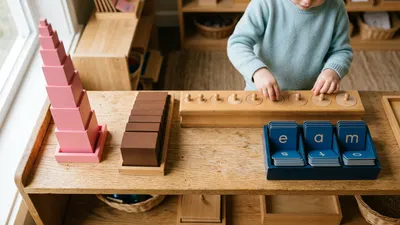
Research consistently documents specific benefits of authentic Montessori programs: stronger executive function, better academic outcomes in reading and math, more developed social cognition, higher intrinsic motivation, and narrowing of socioeconomic achievement gaps. The strongest effects appear in high-fidelity programs followed over multiple years.
When parents ask whether the Montessori method works, they usually want a quick answer: yes or no, do the studies support it. The actual research is more interesting and more useful than a yes/no.
The Montessori method has been studied for over a century, but rigorous modern research — comparing authentic Montessori programs to traditional alternatives, using methods that control for selection bias — really only emerged in the 2000s. The results have been consistent enough to warrant attention from researchers, policymakers, and parents.
This guide walks through what the research actually shows, study by study, claim by claim. The goal is precision: not just “Montessori is good” but specifically what is documented, how it was measured, and where the limits of the evidence lie.
The Methodological Challenge
Before the findings, a note on why this research is hard.
Comparing Montessori to traditional schools is methodologically tricky because the families who choose Montessori are not random. They tend to be more educated, more affluent, more involved in their children’s education. Any comparison that does not control for these differences will overstate Montessori effects.
The best studies solve this through lottery-controlled designs. Public Montessori programs (charters and magnets) typically have more applicants than spots, and admission is decided by lottery. This creates a natural experiment: children who applied and won the lottery vs children who applied and lost. Both groups have similar families and motivation. The only meaningful difference is whether they got into the Montessori program.
When research uses this design, the differences observed can be attributed to the program itself, not to the kind of families who choose Montessori. The most rigorous Montessori studies use this approach.
Finding 1: Stronger Academic Outcomes
The 2006 Lillard and Else-Quest study, published in Science, compared 5- and 12-year-old students at an AMI-accredited public Montessori magnet school in Milwaukee to lottery-controlled peers attending other Milwaukee schools.
For 5-year-olds, Montessori students scored significantly higher on:
- Letter-word identification (reading)
- Applied problems (math)
- Math reasoning beyond rote calculation
For 12-year-olds, Montessori students scored higher on:
- Essay creativity and complexity
- Math problem-solving
- Social skills and community-building
The 2017 follow-up study (Lillard et al., Frontiers in Psychology) tracked over 70 children through their first three years of Montessori at a public program in Hartford. Montessori students gained more in vocabulary, math, executive function, and social problem-solving compared to peers who lost the admission lottery.
Critically, the achievement gap between higher-income and lower-income children narrowed substantially in Montessori. In the comparison schools, income strongly predicted achievement (as it does in most schools nationally). In the Montessori program, this gap was significantly smaller. The method appears to work especially well for children who would otherwise struggle.
Other smaller studies have shown similar patterns: comparable or better academic outcomes in Montessori vs traditional programs, with the strongest effects in math, reading, and writing.
Finding 2: Executive Function
Executive function is the umbrella term for cognitive control: planning, working memory, attentional control, cognitive flexibility, and self-regulation. It is increasingly recognized as one of the strongest predictors of life outcomes — academic success, professional achievement, relationship quality, even physical health.
Multiple studies have documented stronger executive function in Montessori students:
- Lillard 2006 found significant differences in executive function tasks
- A 2017 study by Lillard et al. tracked executive function over 3 years and found Montessori children gaining more than peers
- Smaller studies have replicated these findings across diverse settings
The likely reasons are structural to the method. The 3-hour work cycle requires sustained attention, which trains attentional control. The choice of work requires planning and decision-making, which trains working memory and self-regulation. The care of materials requires impulse control. The mixed-age classroom requires social self-regulation. The absence of external rewards requires intrinsic motivation.
These are precisely the conditions that executive function research identifies as necessary for development. Montessori essentially runs a daily executive-function gym for children, without calling it that.
Why this matters: Executive function in early childhood predicts academic and life outcomes years later, often more strongly than IQ or socioeconomic status. Children who develop strong executive function early are advantaged for decades.
Finding 3: Intrinsic Motivation
Montessori programs do not use grades, gold stars, prize charts, or other external rewards. This is deliberate and rooted in the method’s philosophy: external rewards undermine intrinsic motivation, which is the more durable and powerful form.
Research has consistently supported this. Studies measuring children’s motivation orientations have found Montessori students with stronger mastery orientation (focusing on learning) compared to performance orientation (focusing on outcomes or others’ opinions). Mastery orientation is associated with greater persistence, deeper learning, and better long-term outcomes.
Long-term follow-up studies of Montessori graduates show this pattern persisting. Adults who attended Montessori programs report finding their work intrinsically meaningful at higher rates than comparable peers.
The mechanism is straightforward: when the work itself is satisfying, you do not need external rewards to do it. Montessori children grow up with this internal compass intact. They tend to choose careers and pursuits based on meaning, not on external validation. This is not just a personality trait — it appears to be partially shaped by the educational environment.
Finding 4: Social Cognition and Skills
Multiple studies have documented stronger social cognition in Montessori children:
- Better understanding of others’ perspectives (theory of mind)
- More sophisticated conflict resolution
- Higher rates of cooperative play
- Better empathy and perspective-taking
- Stronger sense of community and belonging at school
The mixed-age classroom is a likely driver. A 5-year-old in a 3-6 classroom interacts daily with 3-year-olds (whom they may help and protect) and 6-year-olds (whom they may emulate). This range of social positioning develops social skills that single-age classrooms cannot match.
The classroom culture itself also contributes. Children speak quietly, respect each other’s work, settle disputes themselves (with adult guidance when needed), and learn explicit lessons in “grace and courtesy” — the Montessori curriculum’s name for social skills.
For parents worried about socialization, the research is reassuring: Montessori children are typically socially more advanced than peers, not less.
Finding 5: Creativity
Creativity research is notoriously hard, but the available studies on Montessori vs traditional students consistently favor Montessori on measures of creative thinking.
Specific findings:
- Montessori 12-year-olds wrote essays scored as more creative and structurally complex than peers (Lillard 2006)
- Studies measuring divergent thinking (generating multiple solutions to open problems) typically favor Montessori students
- Studies of creative problem-solving in math and writing show similar patterns
The likely reasons are again structural. Self-directed work develops the habit of generating one’s own questions and approaches. Hands-on materials encourage exploration. The absence of rigid curriculum allows tangents and deep dives. Mixed-age learning models multiple ways of approaching the same task.
Critically, Montessori does not market itself as a “creative” method. It is structured, materials-based, and sequenced. The creative effects emerge as a byproduct of the broader approach — which is probably why they are robust rather than performative.
Finding 6: Narrowing the Achievement Gap
This may be the most socially significant finding in Montessori research.
In most American schools, family income predicts academic achievement powerfully. Lower-income children consistently lag higher-income peers by significant margins. This gap is one of the major social challenges of American education.
In the 2017 Lillard study, this gap was significantly smaller in the Montessori program than in the comparison schools. Lower-income Montessori students performed much closer to higher-income Montessori peers than the gap seen in traditional schools.
Other public Montessori programs have shown similar patterns. Authentic Montessori appears to be especially beneficial for children who would otherwise struggle in conventional classrooms.
The mechanism is not fully understood, but plausible explanations include: the individualized pacing meets each child where they are; the hands-on materials build understanding for children who may not have strong verbal academic preparation; the calm environment supports children who may face stressors at home; the absence of competitive structures prevents repeated experiences of falling behind.
If this finding holds up in further research, it has significant implications for educational policy. Public Montessori may be one of the few interventions consistently shown to narrow achievement gaps.
Finding 7: Long-Term Effects
Several studies have followed Montessori students into adolescence and adulthood. The findings:
- Higher academic achievement through high school
- Better executive function and self-regulation as adults
- Higher rates of college completion
- Greater life satisfaction in adulthood
- More civic engagement
- Stronger career satisfaction
These long-term findings need more research to be definitive, but the pattern is consistent across studies. The early Montessori advantage appears to compound rather than fade.
This is biologically plausible. Skills like executive function, intrinsic motivation, and social cognition build on themselves. A child who develops strong attention at 6 is better equipped to learn complex material at 10, which prepares them for advanced work at 16, and so on. Foundations matter.
What Does NOT Work as Strongly
Honesty requires noting the findings that are weaker.
Standardized test scores. Montessori students perform comparably or better, but the differences on conventional standardized tests are sometimes modest. The method’s biggest strengths show up in more comprehensive assessments (reading comprehension, math problem-solving, executive function tasks), not always in test-prep style metrics.
Short-term programs. A child in Montessori for one year shows smaller effects than a child in Montessori for 3-6 years. The method works as a coherent system across years. Brief exposure does not produce the full effect.
Low-fidelity programs. Schools that adopt some Montessori elements but not the full system (e.g., materials without the work cycle, or work cycle without proper teacher training) show weaker results. The integrated system matters.
Programs that emphasize academics at the expense of work cycle. Some “Montessori” programs have been pressured by parents to focus more on direct academic instruction and reduce the open work cycle. Research suggests this dilutes the method’s benefits.
What the Research Has NOT Yet Established
Several questions remain open:
Optimal duration. How many years of Montessori are needed to capture most of the benefits? The research suggests at least 3 years, but specific dose-response relationships are not well established.
Best transitions. When Montessori children transition to traditional schools, what helps and hurts? More research is needed on transition strategies and timing.
Specific populations. Most Montessori research has been done with typically-developing children. Effects for children with specific learning differences, gifted children, and children with developmental delays are less well-studied, though anecdotal evidence is generally positive.
Implementation factors. Which specific Montessori elements drive which outcomes? Is it the work cycle? The materials? The mixed ages? The teacher training? Disentangling these is ongoing.
A Practical Synthesis
For parents considering Montessori for their child, the research supports several practical conclusions:
-
Authentic Montessori (AMI or AMS accredited) is associated with measurable academic, social, and executive function benefits compared to comparable traditional programs. These effects are not marginal; they are meaningful.
-
The strongest effects come from multi-year exposure (3+ years). Single-year programs show smaller benefits.
-
Public Montessori programs appear especially beneficial for lower-income children, narrowing achievement gaps that persist in traditional schools.
-
Long-term effects are real. Benefits compound through adolescence and into adulthood.
-
Implementation quality matters enormously. A weak Montessori program may produce no better outcomes than a traditional one. Look for authenticity.
-
Montessori is not magic. It is a coherent educational system with documented benefits and real limitations. It works particularly well for self-directed, focused children, and can be challenging for some children who need more explicit structure.
If you are considering Montessori, the research is encouraging. If you are already in Montessori, the research suggests staying with it for years rather than just one or two. If you are unable to access Montessori, much of what makes it effective can be applied at home — concrete materials, individualized pacing, respect for concentration, intrinsic motivation, and a prepared environment.
The evidence supports the method. The question is what you do with it.