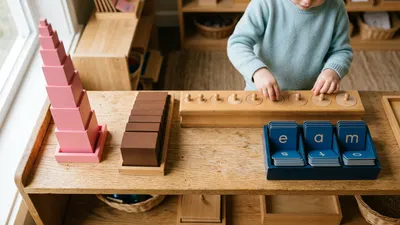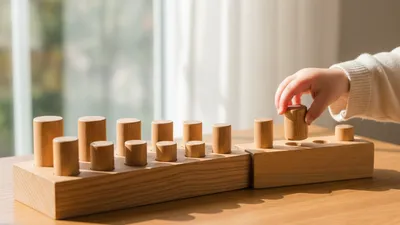
The Montessori method teaches mathematics through a carefully sequenced progression from concrete materials to abstract operations. Children physically manipulate quantities (number rods, golden beads, bead chains) before working with symbols, which builds deep understanding rather than rote memorization. This is why Montessori children typically grasp math operations earlier and more durably than peers learning through workbooks.
If you ask most adults whether they liked math in school, the answer is typically no. If you ask why, the answer is usually some version of: “I never understood what we were doing. I just memorized the steps.” This is the failure of math education in a sentence. Children memorize procedures they do not understand, then forget them, then conclude they are bad at math.
Montessori math is built to prevent exactly this outcome. The method takes a long, patient route through mathematical concepts using physical materials, ensuring that by the time a child works with abstract symbols, they understand what the symbols represent. The result, when the method is implemented well, is children who actually grasp math — who see the structure of numbers, who can extend operations to new situations, who recover when they are confused because they have a foundation to return to.
This guide explains the Montessori approach to math: the philosophy, the sequence, the materials, and why it works. It is not a “best math toys” list (we have a separate guide for that). It is an explanation of how Montessori children actually learn math.
The Underlying Philosophy
Maria Montessori observed that mathematical thinking is built into the human mind. Children naturally count, sort, compare quantities, and notice patterns. The work of math education, in her view, is not to teach math but to develop the mathematical mind the child already has.
This sounds romantic but produced a very specific set of practices.
Concrete before abstract. Mathematical concepts are inherently abstract. A “5” exists only as a concept; you cannot point to it in nature. But concepts are difficult for young children to grasp directly. Montessori bridges this by representing every concept with a physical object first. A child can hold five beads in their hand, feel their quantity, count them, manipulate them. After many such experiences, the abstract “5” becomes meaningful.
Isolated qualities. Each material teaches one specific concept. The number rods isolate quantity. The sandpaper numbers isolate the symbol. The combined work links the two. By keeping concepts separate at first, the child can master each one before relating them.
Control of error. Materials are designed so the child can self-correct without adult intervention. If they made the wrong combination of beads, the result will not equal what they expected. The material itself teaches the right answer.
Repetition. Children return to the same material many times, each time at a deeper level. The pink tower is built first, then built blindfolded, then combined with the brown stair, then used to introduce volume. This deep, repeated work builds robust understanding.
Pace set by the child. No child is rushed to the next material before they have mastered the current one. The sequence is fixed; the pace is individual.
These principles produce a math curriculum unlike anything in traditional schools. Children move slowly through deep concrete work, then make rapid progress through abstraction once the foundation is solid.
The Sequence: How Math Unfolds
Here is the typical sequence of materials and concepts.
Pre-Math (Ages 2-3)
Before formal math materials, children develop the sensory and cognitive foundations through practical life and sensorial work.
Practical life develops concentration, sequencing, fine motor control, and the habit of completing work. All of these are mathematical skills in seed form.
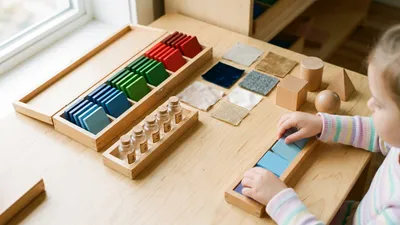
Sensorial materials teach gradation, ordering, comparison, and the precise perception of quantities (the pink tower, the brown stair, the red rods). The red rods, in particular, prepare directly for the number rods.
At this stage, children are not yet doing “math” — they are building the cognitive structures that will support math.
First Math Materials (Ages 3-4)
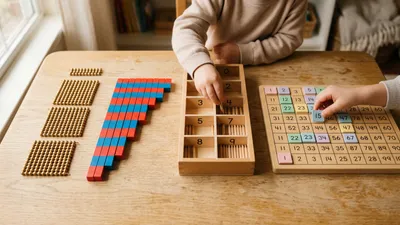
Number Rods. Ten rods of identical thickness but graded length, from 10cm (red) to 1m (red and blue striped). The child arranges them in order and counts them. The number rods make quantity physical: the rod for “5” is actually five times the length of the rod for “1,” and contains five segments.
This is profoundly different from teaching numbers through pictures. The number rods give the child the experience of quantity, not just the symbol.
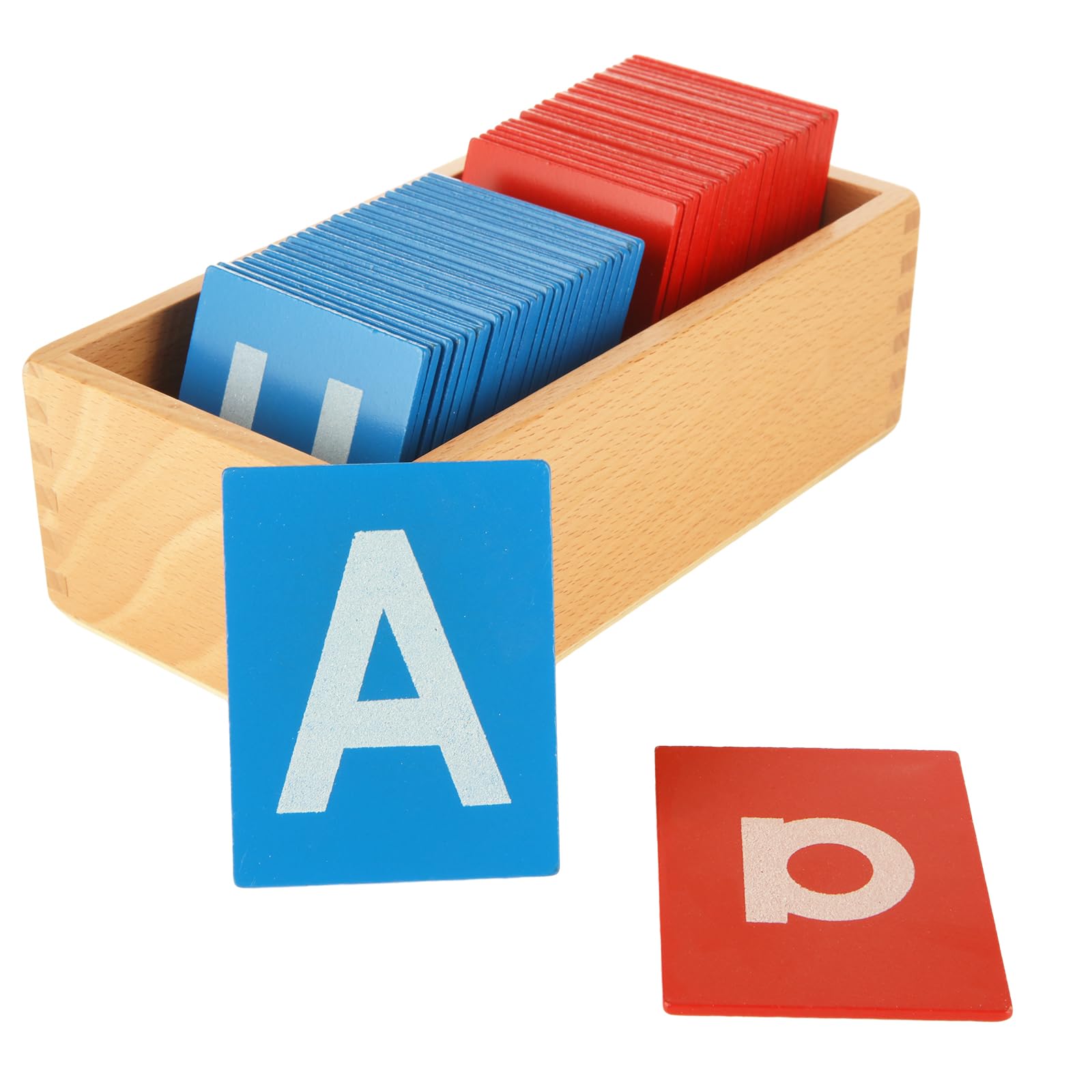
Sandpaper Numbers. The numerals 0-9 cut from sandpaper and mounted on smooth cards. The child traces them with their fingertip, learning the shape of each numeral through touch as well as sight. This prepares for writing numbers.
Combining the Two. The child learns to match each sandpaper number to its corresponding number rod. Now the symbol and the quantity are linked. The number “5” means the rod with five segments. This linking is foundational.
Decimal System (Ages 4-5)
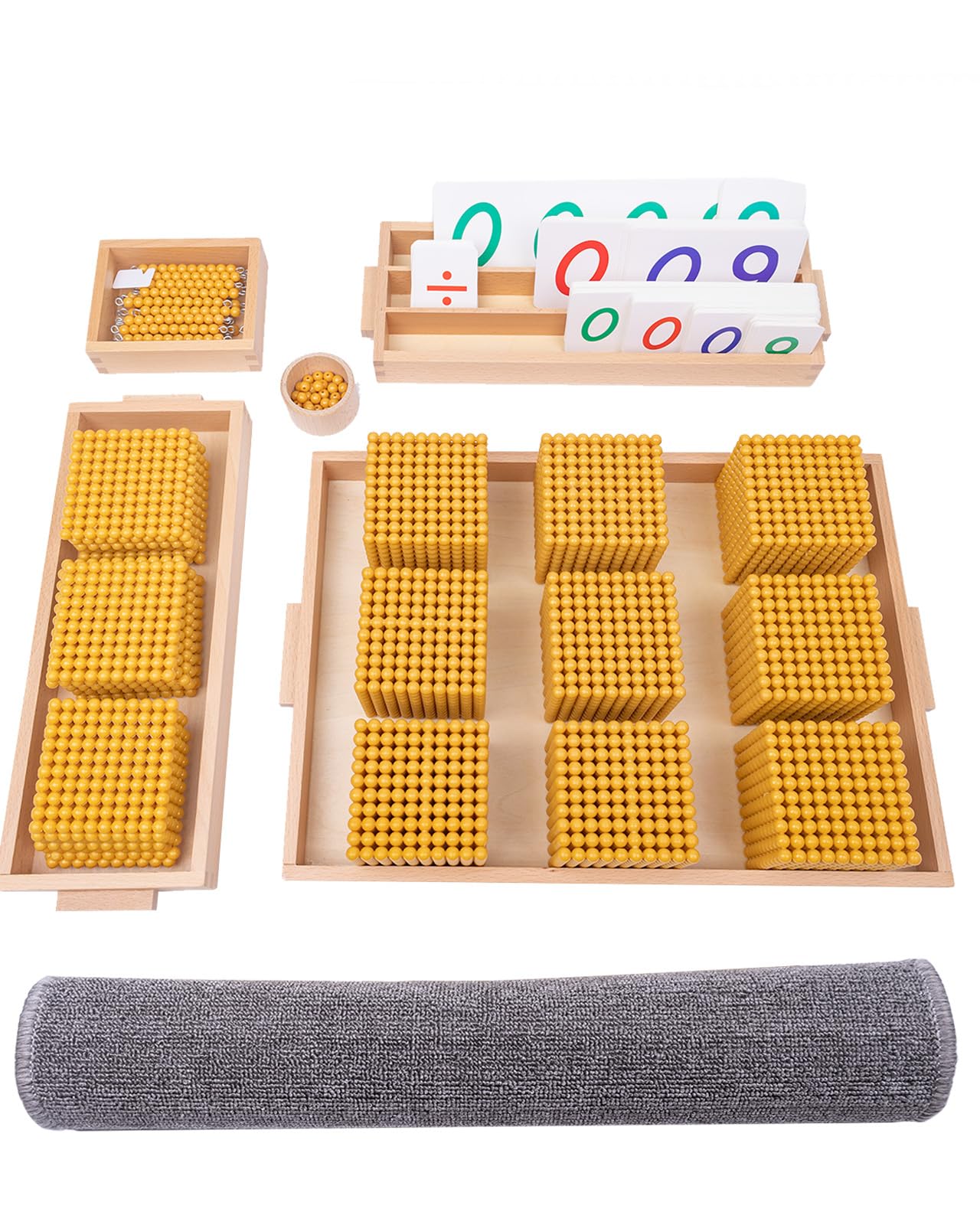
Golden Beads. This is the core Montessori math material. Single beads (units), 10-bead bars (tens), 100-bead squares (hundreds), and 1000-bead cubes (thousands). The child physically experiences the decimal system: a unit is a bead, a ten is ten beads strung together, a hundred is ten tens, a thousand is ten hundreds. The cube shape of the thousand makes the concept of “to the third power” visceral.
Children spend weeks and months working with the golden beads. They count them, build numbers (such as 4,235 = 4 thousand cubes, 2 hundred squares, 3 ten bars, 5 unit beads), and eventually perform operations with them.
Operations with Golden Beads. Addition is performed by combining quantities from two children and counting the total. Subtraction is taking quantities away. Multiplication is repeated addition. Division is sharing quantities equally among multiple children.
This is where Montessori math becomes remarkable. A 5-year-old performing 4,235 + 3,178 using the golden beads is not doing rote arithmetic. They are physically combining quantities and seeing the result. The carrying and borrowing that mystifies many children in traditional math is obvious with the beads: when you have ten units, you trade them for one ten-bar.
Bead Chains (Ages 4-6)
Short and Long Bead Chains. Chains of beads strung in groups representing the squares and cubes of numbers. The 5 chain has 5 groups of 5 beads, totaling 25 (the square of 5). The 5 cube chain has 5 groups of 5 squares, totaling 125 (the cube of 5).
Children lay out these chains across the classroom floor and count them. They use small arrows labeled with intermediate sums (5, 10, 15, 20, 25 for the 5 short chain). They literally walk the length of mathematical operations.
This produces an experiential understanding of squares and cubes that pencil-and-paper math cannot match. A child who has laid out the thousand cube chain (1000 beads in groups representing 10 squared, then 10 cubed) understands what 10 to the third power means.
Transition to Abstraction (Ages 5-7)
Stamp Game. A material that replaces the golden beads with small wooden stamps marked 1, 10, 100, and 1000. The stamps are abstract symbols of the quantities the beads represented. Children perform the same operations they did with golden beads, but now with symbols.
This is the first bridge to fully abstract math. The stamps are smaller and faster to work with than golden beads, but they still preserve the physical organization that builds understanding.
Bead Frame. A horizontal abacus-like material with rows of beads representing units, tens, hundreds, and thousands. Children perform operations by moving beads. The bead frame is even more abstract than the stamp game but still physical.
Multiplication Board. A wooden board with holes for placing colored beads. The child sets the multiplicand at top and adds groups of beads for each multiplication. This teaches multiplication tables through physical work rather than memorization.
Toward Algebra and Beyond (Ages 6-12)
In elementary years, Montessori children move toward fully abstract math, but the foundation built in primary years supports it.
Binomial and Trinomial Cubes. Three-dimensional puzzles that physically embody the algebraic identities (a+b)³ = a³ + 3a²b + 3ab² + b³ and similar. Children build the cubes by placing the corresponding blocks together. By the time they encounter algebra symbolically in elementary, they have already built it physically.
Geometry Materials. Constructive triangles, geometric solids, and 3D shapes that prepare for plane and solid geometry. Children handle, name, and compare shapes long before they study them abstractly.
Bead Frame Operations. Increasingly complex operations performed with the bead frame, eventually transitioning to pencil-and-paper.
Fractions and Decimals. Materials that physically represent parts of a whole, allowing children to manipulate halves, thirds, quarters, fifths, and so on. By the time fractions appear in arithmetic, children understand what they are.
Why This Approach Works
The Montessori approach produces strong math outcomes for several specific reasons.
Conceptual understanding before procedural fluency. Most traditional math teaches procedures (carrying, borrowing, multiplication tables) before children understand what they represent. Children memorize steps and apply them mechanically. When the procedure does not work, they have nothing to fall back on. Montessori reverses this. Children understand what operations mean before they memorize how to perform them efficiently.
A physical foundation to return to. When a Montessori child struggles with an abstract problem, they have a physical material they can return to. A 7-year-old who has forgotten how to do long division can pull out the golden beads and rebuild the understanding. A traditional school child often has only the memorized procedure, which once forgotten is gone.
Pattern recognition through repetition. Children who have built the thousand chain see the pattern of squares and cubes physically. They see why 5 × 5 = 25 in a way that goes beyond memorization. This deep pattern recognition supports later mathematical thinking.
Mathematical reasoning, not calculation. Montessori math is more about understanding mathematical structure than about getting answers quickly. Children develop the habit of asking “why does this work?” rather than just “what is the answer?” This habit transfers to advanced math, where reasoning matters more than memorized procedures.
Confidence built on understanding. Children who actually understand math are confident in math. They will try new problems, persist through difficulty, and recover from errors. Children who only memorize procedures are anxious about math — they know their understanding is fragile.
What Research Shows
Multiple studies have compared Montessori math outcomes to traditional school outcomes.
Lillard 2006 found Montessori 5-year-olds significantly outperforming peers on math reasoning tasks. The 12-year-olds showed strong math problem-solving abilities relative to peers.
Lillard 2017 confirmed and extended these findings over a 3-year longitudinal study, with the income-based math achievement gap narrowing significantly in Montessori programs.
Other studies have shown:
- Montessori students performing comparably to or better than peers on standardized math tests
- Stronger mathematical reasoning and problem-solving among Montessori students
- Better transfer of mathematical concepts to new situations
The research is encouraging without being unanimous, but the overall pattern is clear: authentic Montessori math produces real and lasting benefits.
How to Apply This at Home
If you are homeschooling or supplementing your child’s education, here is how to bring this approach home.
Start with concrete experience. Before any worksheet, before any abstract symbol, give your child quantity to handle. Acorns, blocks, pebbles, beans. Let them count, sort, group, and combine.
Buy the foundational materials. Number rods, sandpaper numbers, and golden beads (introductory set) cover the first 2 years of math beautifully. Total cost: around $200-300.
Resist the urge to push abstract work. Even if your child can recite “5 + 3 = 8,” let them spend time with materials that show what that means. Premature abstraction is the most common mistake.
Follow the sequence. Concrete first. Then representational. Then abstract. In that order, every time.
When in doubt, go back to materials. If your child struggles with anything abstract, ask: would the concrete material help? Almost always, the answer is yes.
Let them work with materials longer than seems necessary. A child who builds the thousand cube fifty times is doing mathematical work that no worksheet can match. Trust the depth.
A Final Thought
Most adults remember math as something they endured. Montessori children, when the method is implemented well, remember math as something they enjoyed.
The difference is not curriculum content. The difference is that Montessori children understood what they were doing, and that understanding made math interesting rather than confusing. The materials revealed the structure of numbers, and children who saw that structure could not help but engage with it.
This is what mathematics is supposed to be: a beautiful, intelligible system that humans have spent millennia exploring. Not a set of procedures to memorize, not a tedious series of worksheets, but a living investigation into pattern, quantity, and relationship.
Montessori math gives children that experience. Whether they go on to become mathematicians, engineers, artists, carpenters, or anything else, they will have started their relationship with numbers in a way that supports them for life.
That is the goal. The materials are just the means.