The Montessori method has real strengths (executive function, intrinsic motivation, mixed-age learning, academic depth) and real limitations (cost, scarcity of authentic programs, weaker fit for some children, transition challenges). This guide examines both honestly, drawing on research and the everyday experience of Montessori families.
When parents ask whether the Montessori method is “good,” they usually mean: is it better than what we are doing now? That is a fair question. It is also a question with a complicated answer.
The honest answer is that Montessori has real strengths and real limitations. It works wonderfully for some children and is a poor fit for others. The research generally supports its effectiveness, but the effects depend on whether the program is authentic, well-implemented, and matched to the child.
This guide takes both sides seriously. We will lay out what the method does well, where it struggles, what the research actually shows, and how to think about fit for your specific family. The goal is not to sell Montessori. It is to help you decide whether it serves your child.
The Strongest Arguments For Montessori
Let us start with what the method does best.
1. Individualized Pacing
This is the single biggest difference between Montessori and traditional education, and arguably its biggest strength. A child in a Montessori classroom moves through the curriculum at their own pace. A 4-year-old reading fluently does not have to wait for the class. A 4-year-old just starting letters does not have to keep up with peers.
In a traditional classroom of 25 children, even an excellent teacher must teach to the middle. Some children are bored; others are lost. In a Montessori classroom, every child is working at the edge of their own capability — the most productive zone for learning. This is a profound structural advantage.
For children who learn quickly, Montessori prevents boredom. For children who need more time on a concept, it prevents the shame and confusion of falling behind. For children who excel in one area and struggle in another, it allows asymmetric progress without dysfunction.
2. Hands-On Learning That Builds Concrete Understanding
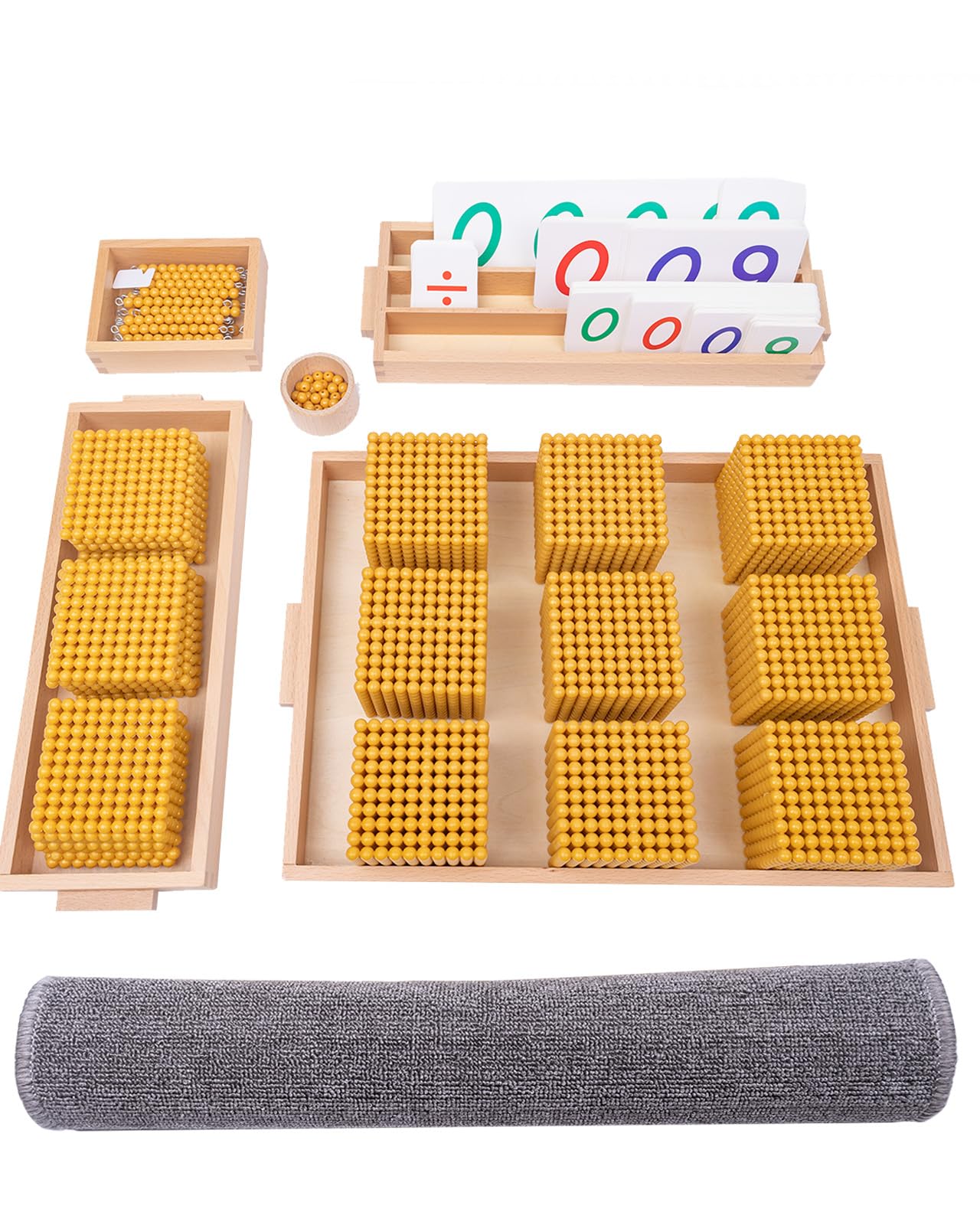
Montessori materials are not visual aids. They are not manipulatives to make abstract lessons concrete after the fact. They are the lesson itself. A child who builds the thousand cube has literally constructed a thousand. A child who manipulates the golden beads to multiply 234 by 6 has done the multiplication with their hands.
This concrete-to-abstract progression is unusual and powerful. Many children who struggle with math in traditional schools are working with abstractions they never grounded in physical experience. Montessori children build the ground first.
The research supports this. Lillard’s 2006 Science study found Montessori 5-year-olds outperformed peers in math, and the effect held into adolescence. The concrete-first approach appears to build durable mathematical thinking.
3. Mixed-Age Classrooms
Montessori classrooms span three-year age groups (3-6, 6-9, 9-12). This is a fundamental design choice and produces several benefits:
- Younger children learn from older children through observation — often absorbing concepts months or years before formal lessons.
- Older children consolidate their learning by demonstrating or explaining to younger children. Teaching is the deepest form of learning.
- Each child is at a different position in the group every year — first as the youngest, then in the middle, then as the oldest — building empathy and perspective.
- Social comparisons are blunted because peers are not all the same age, so comparison is naturally less competitive.
Single-age grouping is an industrial-era convention, not a developmental necessity. Mixed-age learning is closer to how human children have learned for most of history (in family or community groups). The Montessori classroom captures this benefit.
4. Strong Executive Function Development
Executive function is the set of cognitive skills used to plan, focus, switch tasks, regulate emotions, and self-monitor. It is one of the strongest predictors of life outcomes — stronger than IQ on many measures.
Montessori is built to develop executive function. The 3-hour work cycle requires sustained attention. The choice of work requires planning and decision-making. The care of materials requires impulse control. The mixed-age environment requires self-regulation in social situations. The lack of external rewards requires intrinsic motivation.
Research has consistently found Montessori students with stronger executive function compared to peers. A 2017 study by Lillard et al. found notable differences in executive function and intrinsic motivation that persisted across years.
5. Calm and Respectful Classroom Culture
Anyone who has visited an authentic Montessori classroom knows the feeling: it is calm in a way most schools are not. Children speak quietly. They walk rather than run. They respect each other’s work. Conflicts are addressed thoughtfully, often by the children themselves.
This is not because children are forced to be calm. It is because the environment supports calm — meaningful work, freedom of movement, autonomy, mixed ages, and respectful adults. The result is a culture where children spend their school days in a different psychological state than in many other settings.
6. Intrinsic Motivation
Montessori does not use grades, gold stars, charts, or external rewards. Children work because the work itself is satisfying. This is a controversial choice and one of the method’s most distinctive features.
The result, when the method works, is children who do not need external rewards to do meaningful work. Their motivation is internal. This is increasingly valued in modern workplaces and is associated with higher life satisfaction and achievement in adulthood.
Critics worry that Montessori children will not adapt to external systems (school, work) that use rewards. The evidence suggests this is largely a non-issue: most Montessori graduates handle external structures fine and bring superior intrinsic motivation as a complement.
The Strongest Arguments Against Montessori
Now the honest critique.
1. Cost and Access
Authentic private Montessori is expensive. Tuition in the US typically runs $8,000-25,000 per year, similar to other quality private schools. For most families, this is a significant expense. For many, it is impossible.
Public Montessori programs (charters and magnets) exist but are scarce, often heavily oversubscribed, and concentrated in certain cities. Many families who want Montessori cannot access it geographically.
Home Montessori is the most affordable option and can be excellent, but requires parental commitment that not every family can give. For working parents with limited time, home Montessori is often impractical.
The result is that Montessori is more available to higher-income families than lower-income ones. This is a real equity issue and a real limitation of the method’s reach.
2. Scarcity of Authentic Programs
Anyone can call a school Montessori. The name is not trademarked. The result is wide variation in quality.
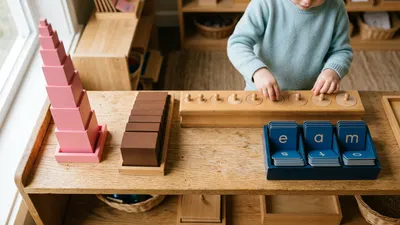
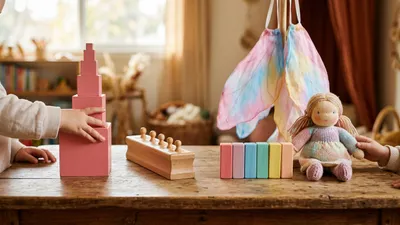
Some “Montessori” schools have a pink tower in the corner but otherwise operate like traditional preschools. Some have the full materials but not the 3-hour work cycle. Some have the cycle but inadequately trained teachers. Authentic AMI or AMS accreditation means much more than the name.
For parents trying to find a real Montessori program, this is a real obstacle. Visit. Ask questions. Look for accreditation. Observe a full work cycle, not just a tour. Authentic programs and weak ones produce very different results.
3. Less Explicit Structure for Children Who Need It
Some children thrive with choice and self-direction. Others struggle. Children with attention difficulties, certain learning differences, or strong needs for explicit external structure may find a Montessori classroom challenging.
A child who would benefit from “now everyone do worksheet 4, then we will do worksheet 5” may not get that level of scaffolding in Montessori. The method assumes the child has the capacity to choose meaningful work. Children who do not have this capacity may flounder or migrate to less productive activities.
A good Montessori teacher can scaffold for these children, but the structural fit is weaker than in a traditional classroom with explicit, sequenced, externally-imposed lessons.
4. Limited Competitive Activities
If your child thrives on competition — math olympiads, spelling bees, debate, competitive sports — Montessori is not the strongest environment. The method actively de-emphasizes competition in favor of internal motivation and personal mastery.
Many Montessori children participate in competitive activities outside school (sports leagues, music competitions, math clubs). But within the program, competitive structures are absent by design.
For some children, this is wonderful. For others, the competitive drive is real and motivating, and a program that does not engage it leaves something on the table.
5. Transition Challenges
Children who move from a Montessori program to a traditional school sometimes struggle with the transition. The challenges are real:
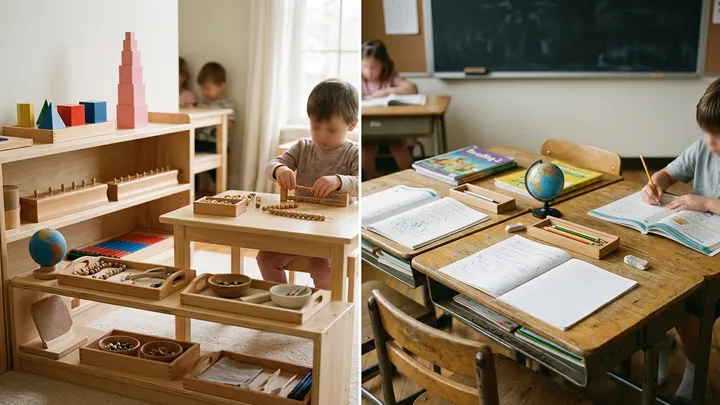
- Adjusting to whole-class instruction after years of individualized pacing
- Sitting still through lessons designed for the average student
- Working within time limits when they have not needed them
- Adapting to grades, tests, and external rewards
- Coping with a classroom culture that may feel chaotic or disrespectful
Most children adapt within a semester or two. Some adapt easily. A few struggle long-term. For families who know they will leave Montessori (e.g., due to relocation, financial change, or limited program availability), this is a real consideration.
6. Limited External Benchmarks
Montessori programs typically do not give regular grades, standardized tests, or formal report cards. For parents who want regular external feedback on their child’s progress, this can be disorienting.
A skilled Montessori teacher can give detailed verbal reports based on observation, and many programs do quarterly parent meetings. But the “B-plus in math, C in history” style of feedback is largely absent.
For some parents this is liberating. For others, it is uncomfortable. Knowing yourself on this dimension matters.
What the Research Actually Says
A few specific findings worth knowing:
Lillard & Else-Quest (2006), Science. Compared 5- and 12-year-olds at an AMI-accredited Montessori magnet school to lottery-controlled peers in traditional schools. Montessori students showed stronger early literacy, math, executive function, and social cognition.
Lillard et al. (2017), Frontiers in Psychology. Followed 70+ children at a public Montessori program over 3 years compared to lottery-controlled peers. Montessori children showed greater gains in academic achievement, social understanding, and mastery orientation. Notably, the income-based achievement gap narrowed significantly in the Montessori program.
Long-term follow-up studies (multiple authors). Adults who attended Montessori programs report higher life satisfaction, stronger executive function, and greater social engagement compared to comparable peers.
Lower-fidelity programs. Studies of programs that adopt some Montessori elements but not others (e.g., the materials without the work cycle) show weaker effects. The method appears to work as an integrated system, not a collection of optional components.
The research is encouraging but not unanimous. Some studies show smaller effects or no significant differences. The overall pattern: authentic Montessori produces real, lasting benefits, especially in executive function and motivation, with academic outcomes comparable or better than traditional programs.
How to Decide
Here is a framework for thinking about whether Montessori fits your family.
Strong fit indicators:
- Your child engages deeply with self-chosen activities
- Your child shows natural concentration when interested
- Your child has been described as independent or self-directed
- You value autonomy and intrinsic motivation
- You can either afford private Montessori or commit to home practice
- You can access an authentic, accredited program
Weaker fit indicators:
- Your child needs explicit external structure to focus
- Your child thrives on whole-class energy and group learning
- Your child has strong competitive drives that need engagement
- You want regular external feedback on academic progress
- You will be transitioning to traditional school in the near future
- The only available “Montessori” program is low-fidelity
Neutral indicators (handle on a case-by-case basis):
- Your child has special needs (depends heavily on the program)
- Your child is shy or highly social (both can work in Montessori)
- Your child is academically advanced or struggling (Montessori adapts to both)
- Your family is bilingual or multilingual (Montessori usually accommodates well)
A Final Word on Honesty
Montessori works. It also has costs and limits. Anyone who tells you the method is universally superior is selling you something. Anyone who tells you it is just a fad has not looked at the research.
The truth is that Montessori is one of several serious educational approaches that produce excellent outcomes when implemented well. It has distinctive strengths and real weaknesses. It suits some families and not others.
The right question is not “is Montessori the best?” The right question is “would Montessori serve my specific child better than the alternatives we are realistically considering?” That question has an answer for your family, and answering it honestly is more useful than any general endorsement or critique of the method.
If after reading this you are leaning toward Montessori, our guide to the method goes into more detail on the underlying philosophy. If you are leaning away, that is also a reasonable conclusion. The goal is a thoughtful match between your child and the environment they spend years in, not adherence to any specific educational philosophy.
Decide carefully. Then commit.