Maria Montessori (1870-1952) was an Italian physician, educator, and reformer who developed an educational method that has spread to more than 100 countries. She pioneered research into early childhood development, advocated for women’s rights, was nominated for the Nobel Peace Prize three times, and trained generations of teachers who carried her work into the modern era.
Maria Montessori was a complicated, brilliant, fierce woman who built a system of education that has outlived her by more than 70 years and continues to spread. She was also one of Italy’s first female physicians, a public intellectual, a single mother in an unforgiving culture, a refugee from fascism, and a three-time Nobel Peace Prize nominee.
To understand her method, it helps to understand her life. The two are inseparable. The educational philosophy she developed reflects everything she fought for personally — independence, dignity, capability, the right of the underdog to become more than what society expected. She built schools the way she lived: with discipline, with conviction, and with a refusal to accept that anyone — child, woman, or marginalized person — was incapable.
This is the story of how that life produced the method.
Early Life: Italy, 1870-1890
Maria Montessori was born on August 31, 1870, in the small Italian town of Chiaravalle, the same year Italy was completing its unification as a modern nation-state. Her father, Alessandro Montessori, was a civil servant of conservative inclinations. Her mother, Renilde Stoppani, was a well-read woman from a family of educators and clergy.
The family moved to Rome when Maria was 12. Her education from this point was unconventional for an Italian girl of the era. She attended a technical school — usually a path for boys — and excelled in mathematics and science. By her late teens she was considering engineering as a career, which would have been remarkable; by 1890 she had decided on medicine, which was nearly unthinkable.
Italian universities were not officially closed to women, but in practice, women medical students were rare and faced sustained opposition. Her father initially objected; he wanted her to become a teacher. Her mother supported her. Maria was admitted to the University of Rome, where she studied medicine, anatomy, and the new fields of psychiatry and pediatrics.
She graduated in 1896, becoming one of Italy’s first female physicians and among the first in continental Europe. The achievement made her a public figure almost immediately.
Early Career: Medicine and Marginalized Children
Her first major work after graduation was at the University of Rome’s psychiatric clinic, where she encountered children classified as “deficient” — typically those with intellectual disabilities, behavioral problems, or developmental delays. These children were warehoused in institutions with adults. They received little stimulation, no education, and minimal expectation of capability.
What Montessori observed was striking. These children, when given even simple objects to manipulate, engaged with them intensely. They were not, as the culture assumed, beyond reach. They were starved — for stimulation, for engagement, for treatment as humans.
She began developing teaching methods adapted from earlier educators (Jean Itard, Edouard Seguin) who had worked with similar populations. She visited their schools in France, studied their materials, and refined her own approach in Italy. The results were transformative. Children long considered uneducable learned to read, write, and care for themselves. Some performed academically as well as typical children at state schools.
The discovery that changed her life: if these methods worked for “deficient” children, what could they do for ordinary children? The answer would come a decade later, when she was given the opportunity to find out.
1907: The First Children’s House
In 1907, the Roman Association for Good Building was developing low-income housing in the San Lorenzo district of Rome. They had a problem: while parents were at work, their young children (ages 3-6) ran wild through the buildings, damaging property and disrupting other tenants. The association offered Montessori a small space and a request: take charge of these children during the day.
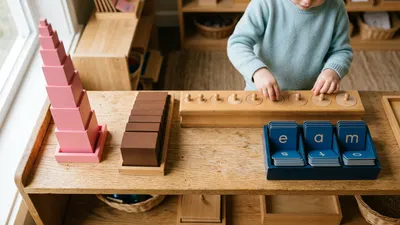
She agreed, on her terms. The space was called Casa dei Bambini — Children’s House. She set up child-sized furniture, provided her teaching materials, and trained a young woman as the daily caretaker. Maria herself observed.
What happened in the next few months made her famous.
The children, many of them malnourished and previously without any structured environment, transformed. They settled into long periods of concentrated work with the materials. They learned to wash themselves and care for the room. They developed strong concentration. They became, in Maria’s word, “normalized” — moving from chaotic to focused.
Most strikingly, they began to read and write at remarkably young ages — sometimes as young as 4. They worked with advanced mathematical materials. They showed empathy and care for each other. They behaved, in many ways, more maturely than middle-class children at established schools.
Word spread quickly. Educators from across Europe and the United States came to Rome to see for themselves. By 1909, Casa dei Bambini was famous internationally. By 1910 there were Montessori schools across Italy, with more in Germany, Spain, the Netherlands, Switzerland, and the United States.
Maria had stumbled onto something she had not been looking for. She thought she was running an educational experiment for poor children. She was actually rewriting the foundations of childhood education.
1910s-1920s: International Expansion
From 1910 onward, Maria devoted herself to spreading the method. She wrote Il Metodo (later translated as The Montessori Method) in 1909, a book that quickly became internationally influential. She gave lectures across Europe and made multiple trips to the United States. In 1913 she met President Woodrow Wilson and was received as a major intellectual figure.
She trained teachers personally. Her teacher training courses became famous and demanding — students traveled from around the world to study with her, sometimes for years. She insisted on personal certification of teachers, which became controversial when the demand outstripped her ability to train.
In 1929 she founded AMI (Association Montessori Internationale), an organization to preserve the integrity of the method as it spread. AMI continues today as one of the two major Montessori accrediting bodies (along with AMS, the American Montessori Society, founded in 1960).
By the late 1920s, Montessori schools existed across the world. The method was at the height of its first wave of influence. Maria was a global figure.
The Personal Cost
Her public success came at a personal price.
In the 1890s, while still a young physician, she had a relationship with a colleague, Giuseppe Montesano. She became pregnant. The social pressures of the era were severe — an unmarried mother in 1898 Italian Catholic society faced enormous stigma, particularly a professional woman whose career depended on respectability.
Her son, Mario, was born in 1898. She did not marry his father (who later married someone else). She also did not raise Mario directly in his early years — he was placed with a foster family and later raised by family connections. Maria visited but did not openly claim him as her son.
This decision was painful. It was also pragmatic, in the calculus of that era. She protected her career, which protected her ability to do the work that would shape millions of lives. But the cost to her personally and to Mario was real.
Mario reentered her life in adolescence. They became close, and from 1918 onward he was her constant collaborator. He traveled with her, helped run AMI, and led the organization after her death. His own children carried the work into the third generation.
1934: Conflict with Fascism
By the early 1930s, Mussolini’s fascist regime had consolidated power in Italy. Initially, Mussolini supported Montessori schools — they were a source of international prestige and seemed compatible with his rhetoric about Italian civilization.
But Maria refused to align her schools with fascist youth indoctrination. She would not wear the uniform of fascist support. She would not have her children indoctrinated. The conflict came to a head in 1934, when Mussolini closed all Montessori schools in Italy.
Maria left Italy. She would not return for a decade.
She settled first in Spain, then in the Netherlands, continuing to teach and write. AMI continued operating from outside Italy.
World War II: Internment in India
In 1939 Maria and Mario went to India for what was meant to be a lecture tour. World War II broke out while they were there. As Italian nationals in a British territory at war with Italy, they were interned.
Mario was placed in an internment camp. Maria, then 69 years old, was placed under house arrest. They remained in India for seven years.
This could have been a time of bitter inactivity. Instead, Maria turned it into one of the most productive periods of her career. She trained Indian teachers. She refined her approach to elementary education. She wrote some of her most important works during this period, including The Absorbent Mind (1949). She influenced an entire generation of Indian Montessori educators whose work continues today.
By the war’s end she was 75 and had been politically displaced for 12 years. She returned to Europe, settled in the Netherlands, and continued working until her death.
1949-1952: Nobel Nominations and Final Years
In her last years, Maria Montessori was recognized as a major global figure for peace through education. She was nominated for the Nobel Peace Prize in 1949, 1950, and 1951. She did not win, but the recognition cemented her status.
Her core thesis at this stage was that education was the foundation of lasting peace. The brutality of two world wars had shaped a generation of European thinkers who looked for the roots of mass violence and sought ways to prevent its return. For Maria, the answer was in how children were raised. A child raised with respect, autonomy, and meaningful work would become an adult capable of cooperation and unable to tolerate authoritarianism. Children were the long game of peace.
She died on May 6, 1952, in Noordwijk, the Netherlands, at age 81. She was buried there. Her grave bears a simple inscription: Io prego i cari bambini, che possono tutto, di unirsi a me per la costruzione della pace negli uomini e nel mondo. (“I pray the dear children, who can do anything, to join me in the construction of peace in mankind and in the world.”)
Legacy
When Maria died, there were Montessori schools in dozens of countries. Today there are an estimated 60,000+ programs worldwide, including over 5,000 in the United States. The method has spread to nearly every country with public education and to many private and home-based programs.
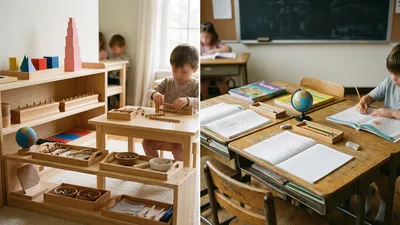
Her influence extends well beyond explicitly Montessori schools. Her ideas — hands-on learning, mixed-age classrooms, respect for the child as a competent individual, the importance of the prepared environment — have shaped early childhood education broadly. Practices that are now mainstream (child-sized furniture, learning centers in classrooms, individualized pacing) trace back at least in part to her work.
Notable Montessori-educated figures include Larry Page and Sergey Brin (founders of Google), Jeff Bezos (founder of Amazon), Anne Frank, Gabriel García Márquez, Julia Child, and Beyoncé. While Montessori does not “produce” any specific type of person, the consistency with which Montessori graduates appear in fields requiring independence, creativity, and self-direction is suggestive.
The research base on her method has grown significantly. Studies like Lillard 2006 in Science and Lillard 2017 in Frontiers in Psychology have given the method modern scientific validation. Several public Montessori programs have shown dramatic results with low-income populations, narrowing achievement gaps that traditional schools have struggled to address.
Her books remain in print. Her teacher training continues through AMI, AMS, and other bodies. The method continues to evolve while remaining recognizable as the same approach Maria developed in Casa dei Bambini in 1907.
What She Would Want You to Know
If you could ask Maria Montessori what she would want modern parents to take from her work, the answer would probably be simple. Trust the child. Prepare the environment. Step back when you can. Step in when you must. Watch carefully. Respect what you see.
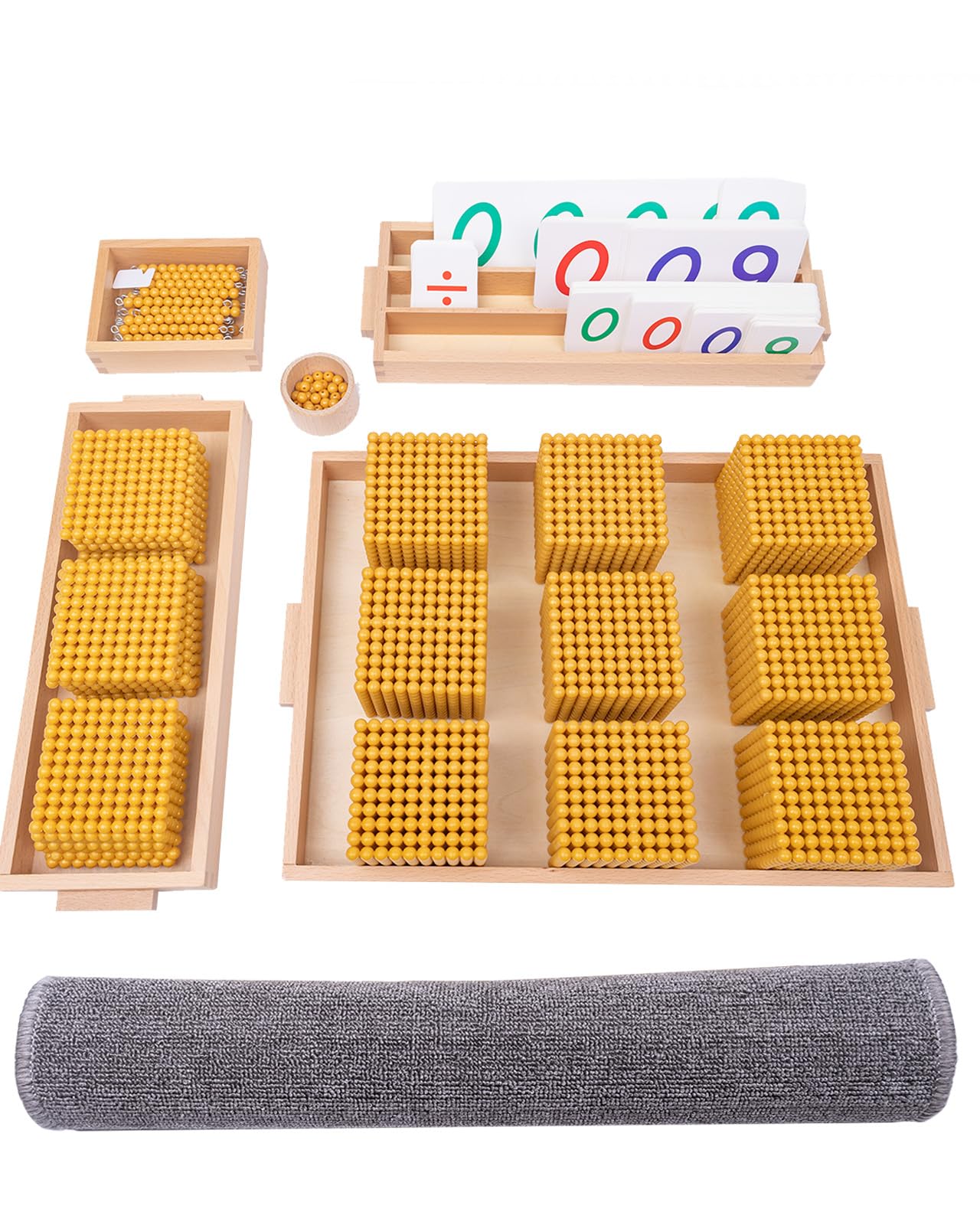
She would probably also want you to know that the method is not a brand. It is not a set of toys. It is not a marketing identity. It is a sustained practice of seeing children as capable and treating them accordingly. The materials are useful, but they are not the point. The point is the child, becoming who they are meant to become, with the support of adults who have stepped out of the way.
That insight — that the adult’s deepest work is often to do less rather than more — was her gift. A century after the first Children’s House, it remains as radical and useful as it was in 1907.
She would probably want you to know one more thing: she was not unique. Anyone who learns to see children this way can do what she did, in their own way, in their own home. The method is portable. The vision is available.
It only requires the willingness to slow down, watch, and trust.