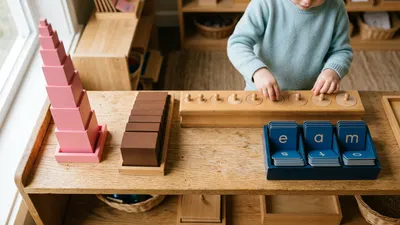
Montessori parenting applies the principles of the Montessori educational method to family life: prepared environment, freedom within clear limits, respect for the child as a competent individual, and observation as the primary parental skill. It is different from gentle parenting or authoritative parenting in specific ways and produces a distinctive parent-child relationship.
There is a moment that defines Montessori parenting, and it usually happens in the kitchen.
A two-year-old wants to pour their own milk. The parent has a choice. The traditional impulse is to take the carton, do it for them, and move on with breakfast in the 90 seconds it should take. The Montessori impulse is to let the child do it, with a smaller pitcher, on a tray that will catch the spills, knowing that this morning will take longer and there will be milk on the floor.
If you choose the second option, and choose it again the next day, and the next, and the next, something accumulates. By age 4 your child is pouring their own water from a glass pitcher into a glass cup with confidence. By 6 they are making toast and packing their own lunch box. By 10 they are doing their own laundry. By 16 they are running their own life with a degree of capability that startles people.
That accumulation is what Montessori parenting is. It is not a style. It is a long, patient series of small decisions to let the child do the thing themselves, in an environment prepared for them to succeed.
This guide explains the principles, daily practices, and underlying philosophy of Montessori parenting. We will be specific about what is different from other approaches and concrete about how it looks at home.
The Five Core Principles
1. The Prepared Environment
The most distinctive Montessori parenting practice is environmental, not behavioral. The home is set up so the child can do things themselves.
This means: low hooks for coats, a step stool at the sink, child-sized utensils and cups, a small pitcher of water in the fridge, books on low shelves, clothes hung at child height, a small broom and dustpan, a small chair at the kitchen counter. The home does much of the parenting work by removing the daily friction that requires adult intervention.
When you walk into a Montessori home, you see this immediately. A 3-year-old gets their own water. A 4-year-old gets dressed without prompting. A 5-year-old sets the table. None of this requires perfect children or perfect parents — it requires an environment that makes these things possible.
2. Freedom Within Limits
Children have real autonomy in clearly defined areas, with firm limits where the limits matter.
Real freedoms include: choosing what to wear (from prepared options), choosing what to eat (from prepared options), choosing where to play, choosing what to do during free time, choosing when to finish a meal, choosing whether to nap.
Firm limits include: bedtime routines (the structure is non-negotiable, the details flexible), safety rules (holding hands crossing the street), basic respect (no hitting, no destruction), care of the environment (we put things away).
The combination is precise. The child experiences daily autonomy in dozens of small choices. The parent maintains structural integrity where it matters. This is harder than either extreme — pure compliance or pure permissiveness — and produces a different kind of child.
3. Respect for the Child
The Montessori parent treats the child as a competent individual from birth. This shows up in dozens of small ways:
- Speaking to the child in full sentences, not baby talk
- Explaining what you are doing before you do it (“I am going to pick you up now”)
- Asking the child’s opinion when it matters and listening to the answer
- Treating their work seriously — a 2-year-old stacking cups deserves the same respect as an adult writing a report
- Not interrupting concentration
- Apologizing when the parent is wrong
- Not lying or manipulating, even to make a tough moment easier
Respect is not gentleness. It is treating the child as a full person whose dignity matters, even when they are unable to articulate that need.
4. Observation as the Primary Parental Skill
In Montessori parenting, observation is more important than reaction. Parents spend significant time watching their children — not surveilling, but attentive, present observation.
What they are watching for: what interests the child today, what skills they are working on, what they need more of, what is causing struggle, what is being mastered. The information from this observation guides everything else — what to introduce next, when to step back, when to step in, what the child is becoming.
This is harder than reactive parenting. It requires sitting with apparent inactivity, resisting the urge to direct or entertain, and trusting that observation will produce information worth having. Most parents are not trained for this and find it uncomfortable at first.
5. Trust in Development
The deepest Montessori principle is trust in the child’s developmental drive. Children come into the world with an inner pull toward growth — toward standing, walking, talking, reading, doing. The parent’s job is not to push this growth but to create conditions for it to unfold.
This means: not rushing milestones, not comparing to other children, not panicking when something is delayed, not bribing or pressuring for results. The development will happen if the environment supports it. The parent’s anxiety adds nothing useful.
This is the hardest principle for many parents, especially in a culture that constantly compares children and pushes for early achievement. But it is also the most liberating. When you trust the development, you can stop performing parenting and start enjoying it.
What This Looks Like in Daily Life
The principles translate to specific practices throughout the day.
Morning
Your child wakes up in their own bed (a floor bed if possible). They can get up when they wake. They go to their accessible wardrobe and choose an outfit from 3-4 prepared options. They dress themselves, with help only where needed.
In the kitchen, they have a step stool at the counter, a small pitcher of water, their own cup, and child-sized dishes. They participate in breakfast: maybe pouring cereal, getting their own water, putting their plate in the sink when done.
This sounds elaborate. It is not. It is the result of a one-time setup. After that, the morning runs itself.
Throughout the Day
You speak to your child the way you would speak to a guest. You explain what you are doing. You ask their input on real questions. You let them do things slowly. You watch when they are absorbed and protect their concentration. You step in when needed and out when not.
When your child wants to do something risky, you assess: real risk or just discomfort for you? Real risk warrants intervention. Discomfort for you is information about your own fears, not about the child’s safety.
When your child is bored, you do not entertain them. Boredom is the soil of creativity. They will find something to do — perhaps after 20 difficult minutes of complaining. The first thing they find may be unimpressive (a stick in the yard). The fifteenth thing they find this week may be deeply absorbing.
Conflict
Your child does something you do not like. The Montessori response is not punishment, not negotiation, not lengthy explanations.
Step 1: Stay regulated. Your calm is the foundation.
Step 2: State the limit clearly and briefly. “I will not let you hit your brother.”
Step 3: Physically intervene if needed, with respect (“I am going to move your arm so it does not hit”).
Step 4: Acknowledge the underlying feeling without endorsing the action. “You are angry. That is okay. Hitting is not.”
Step 5: When the storm passes, reconnect. Not as a reward, but because relationship is the underlying ground.
Step 6: Repair if needed. “When you are ready, you can help your brother feel better.” But do not force apologies — they are meaningless when forced.
Notice what is absent: yelling, time-outs (in the punishment sense), elaborate explanations, threats, bribes, or shaming. The conflict is handled with minimal drama and the relationship is preserved.
Bedtime
A consistent, calm routine: bath, pajamas, brushing teeth, books, lights out. The structure is firm. The details flexible (which book, which pajamas, which song).
Your child sleeps in their own bed in their own room (or shared with siblings). If they get up, you walk them back calmly, with minimal words. The third or fourth time, the same way. The seventh time, the same way. Consistency is the discipline. Children sense when bedtime is negotiable and exploit it. They sense when it is not and adapt within days.
Common Misconceptions
“Montessori parenting is permissive.” It is not. It is highly structured. The freedoms exist within firm limits that the parent maintains without negotiation.
“Montessori parents do not discipline.” They do, but through natural consequences, clear limits, and the structure of the environment. They do not use punishment as a tool, because punishment damages the relationship and produces external rather than internal regulation.
“Montessori parenting is exhausting.” The first year of implementation is exhausting because you are building habits. After that, the parenting is actually less exhausting than the alternatives. A child who dresses themselves, gets their own water, and can be left to play for an hour without entertainment is a less exhausting child to raise.
“Montessori parents do not yell.” They try not to, and over time mostly succeed, but they are still human. The difference is what happens after the yell: apology, repair, and a return to the underlying respect.
“Montessori parents do not play with their children.” They do, but they do not perform for them. Play is genuine, mutual, and not a service the parent provides on demand. Many Montessori parents play less but more meaningfully than other parents.
“You have to do everything for it to work.” You do not. Pick one principle. Start there. The approach is fractal: each part contains the whole.
Where Montessori Parenting Struggles
Honest acknowledgment: this approach is not perfect.
It requires patience that not everyone has access to. Single parents, working parents, parents in crisis — all may struggle to find the slow, observation-based rhythm Montessori parenting requires.
It requires a partner who is at least partially on board. A child getting two different sets of rules in two parts of the house gets confused. Some Montessori families navigate this; many struggle.
It is harder with multiple children of similar ages. The setup work multiplies. The observation work fragments. Real-world Montessori parenting of multiple young children is more chaotic than the Instagram version.
It requires cultural support that is sometimes absent. Extended family, friends, and other caregivers may have very different ideas about how to interact with children. Repeatedly fighting these is exhausting and sometimes damaging.
The early returns are slow. A traditional parent who uses bribery and threats can get short-term compliance quickly. A Montessori parent who refuses to use these tools may have a 6-month period of looking less effective before the long-term benefits emerge.
These are real costs. They do not invalidate the approach, but they do explain why it is harder than it sometimes looks.
How to Start
You do not need to overhaul everything overnight. The approach is more like a long renovation than a quick redesign.
Week 1. Walk through your home from your child’s height. Notice what is impossible for them to do independently. Pick three things to make accessible (a low hook, a step stool, a small pitcher of water).
Month 1. Start observing your child for 15 minutes a day without intervening. Just watch. Notice what they do, what they are working on, what interests them. Resist the urge to teach, narrate, or direct.
Month 2. Identify one routine where your child can do more themselves (getting dressed, setting the table, packing the diaper bag, cleaning up after meals). Set up the environment to make it possible. Slow down and let them.
Month 3. Notice your own language. Are you using baby talk? Are you commenting on every small action? Are you bribing or threatening? Pick one habit to shift.
Month 6. Look at how your child has changed. Most parents see significant differences by this point. The child is more independent, more focused, more cooperative. The relationship has shifted.
This is the long, patient path. There is no shortcut. The work is in the daily decisions, made one at a time, over years.
Recommended Reading
If you want to go deeper, three books are particularly valuable:
“The Montessori Toddler” by Simone Davies. Practical, modern, parent-friendly. Probably the best starting point.
The Montessori Toddler by Simone Davies
“How to Raise an Amazing Child the Montessori Way” by Tim Seldin. A comprehensive overview of Montessori parenting from infancy through adolescence.
How to Raise an Amazing Child the Montessori Way
“Montessori from the Start” by Paula Polk Lillard and Lynn Lillard Jessen. The classic on Montessori in the first three years, written by Maria Montessori’s spiritual descendants.
Disclosure: As an Amazon Associate, we earn from qualifying purchases. This does not affect the price you pay or which books we recommend.
A Final Thought
The deepest gift of Montessori parenting is not what it does for the child. It is what it does for the parent.
When you treat your child as a competent person, you become a different kind of person yourself. You become more patient, more observant, more trusting. You learn to be quiet when you would normally talk, to wait when you would normally rush, to step back when you would normally help. These are not just parenting skills. They are life skills, and they make the rest of your life better too.
Children raised this way grow up. The Montessori toddler becomes the Montessori 8-year-old, then the Montessori teenager. Each stage is different, but the underlying relationship — respect, trust, presence — remains.
By the time your child is grown, you will not remember most of the small decisions you made along the way. The morning you let them spend 15 minutes pouring their own milk. The afternoon you sat and watched them play instead of organizing the closet. The night you held the bedtime line even when it would have been easier to give in.
But the cumulative effect of those decisions will be visible. You will have a child who can do their own life, who treats other people with respect, who knows what they want and how to pursue it, and who likes you.
That is the goal. The method is just the path.